

Sep 4, 2026
Why the Carolinas are Emerging as a Multifamily Development Hotspot

Traded Editorial
Key Points
- Durham, NC, led the nation in multifamily permitting intensity during the first half of 2026, with 45.2 units authorized per 10,000 residents.
- Raleigh, NC, Columbia, SC, and Charlotte, NC, helped place four Carolina metros among the top 12 U.S. markets for multifamily permitting intensity.
- Columbia posted the fastest year-over-year permitting growth among the 100 largest U.S. metros, with authorized units increasing 468% from the first half of 2025.
- The Carolinas outperformed much of the South, where most major metros experienced year-over-year declines in multifamily permitting.
Multifamily development is becoming more selective across the U.S., but the Carolinas are emerging as one of the nation’s strongest regional hubs for new apartment supply.
New U.S. Census Bureau data highlighted by Chandan Economics and Arbor Realty Trust show that North and South Carolina are capturing an outsized share of multifamily permitting activity at a time when national conditions are stabilizing and many Southern markets are losing momentum.
Influx of Carolinas Renters Helped These Metros Top Rankings
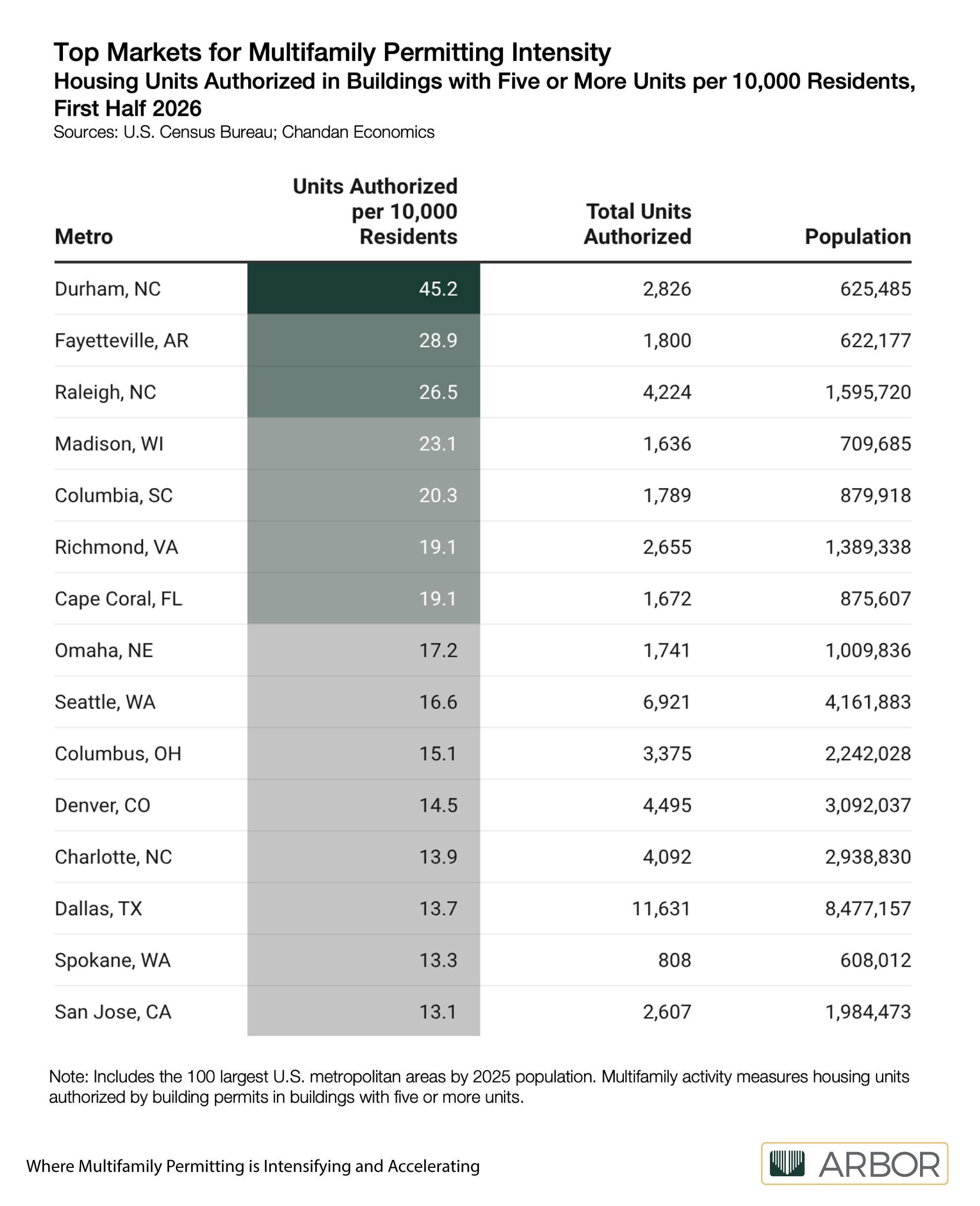
Durham was the clearest leader during the first half of 2026.
Among the 100 largest U.S. metropolitan areas, Durham ranked first in multifamily permitting intensity, authorizing 2,826 units in buildings with five or more units, or 45.2 units per 10,000 residents.
Raleigh ranked third nationally at 26.5 units per 10,000 residents, while Columbia ranked fifth. Charlotte also finished among the top 12.
Together, those rankings show that the Carolinas are not benefiting from a single breakout market. Instead, its strength in multifamily development is derived from the outperformance of several metros.
The concentration of activity also reflects strong demographic fundamentals. According to Arbor’s new research, South Carolina led the nation in population growth in 2025 at 1.5%, while North Carolina ranked third at 1.3%.
These new population gains in the Carolinas are helping support housing demand and giving developers additional reasons to pursue new multifamily projects across the region.
Region Rapidly Builds Multifamily Momentum
Columbia may be the best example of how quickly multifamily momentum is building in the Carolinas.
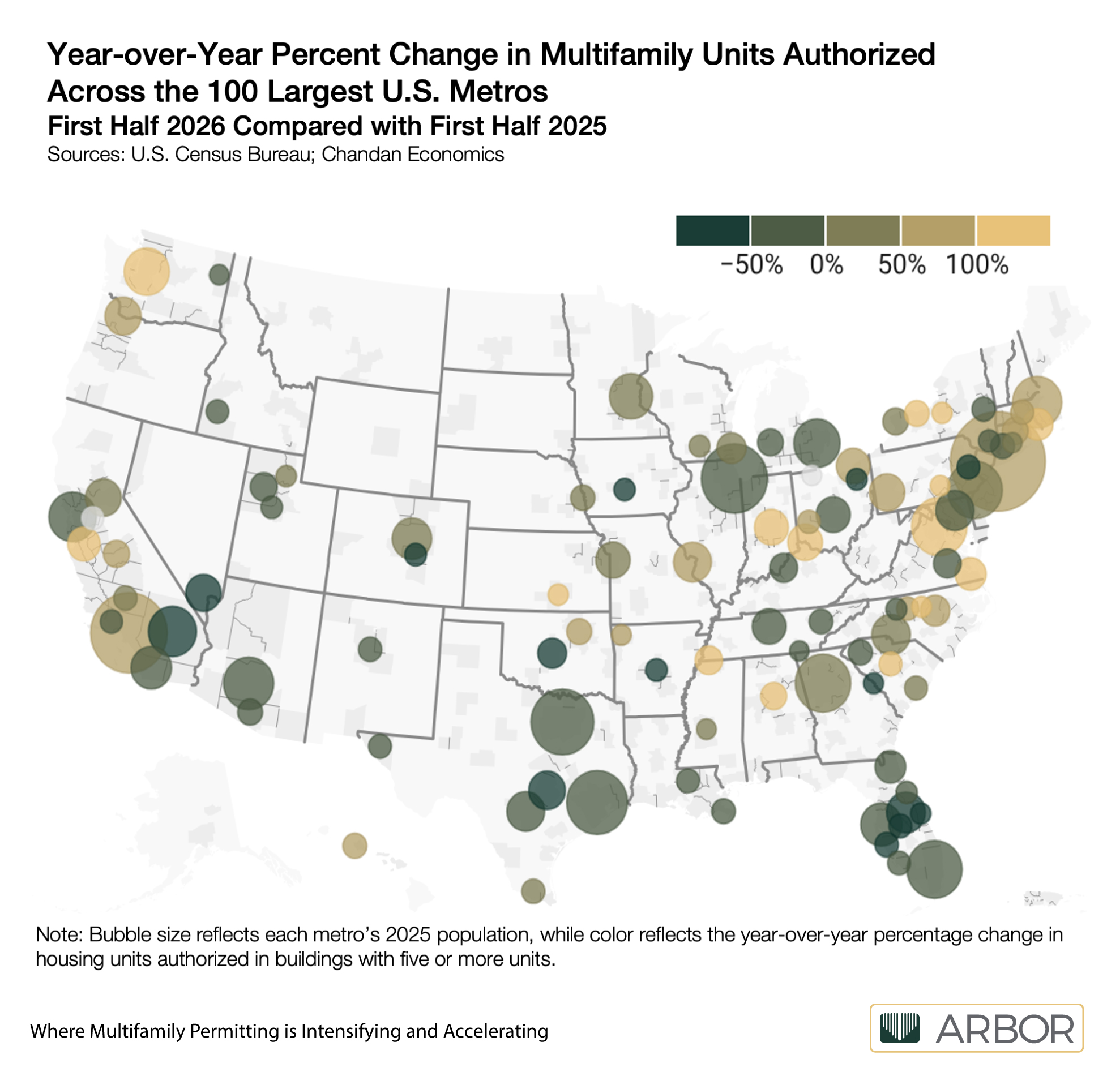
In addition to ranking fifth nationally for permitting intensity, the South Carolina capital recorded the largest year-over-year increase in authorized multifamily units among the 100 largest U.S. metros.
Permitting in Columbia increased 468% compared with the first half of 2025, placing the market first nationally for permitting acceleration.
Although the nation’s strongest permitting activity is not necessarily concentrated in large metropolitan areas, seven of the eight leading markets for multifamily permitting intensity had fewer than 1.5 million residents.
Durham fits squarely within that pattern, demonstrating how smaller, fast-growing metros can attract significant development when population, employment, and housing fundamentals remain favorable.
The Carolinas Diverge from the Rest of the South
The Carolinas' strength is particularly notable because it contrasts with broader conditions across the South.
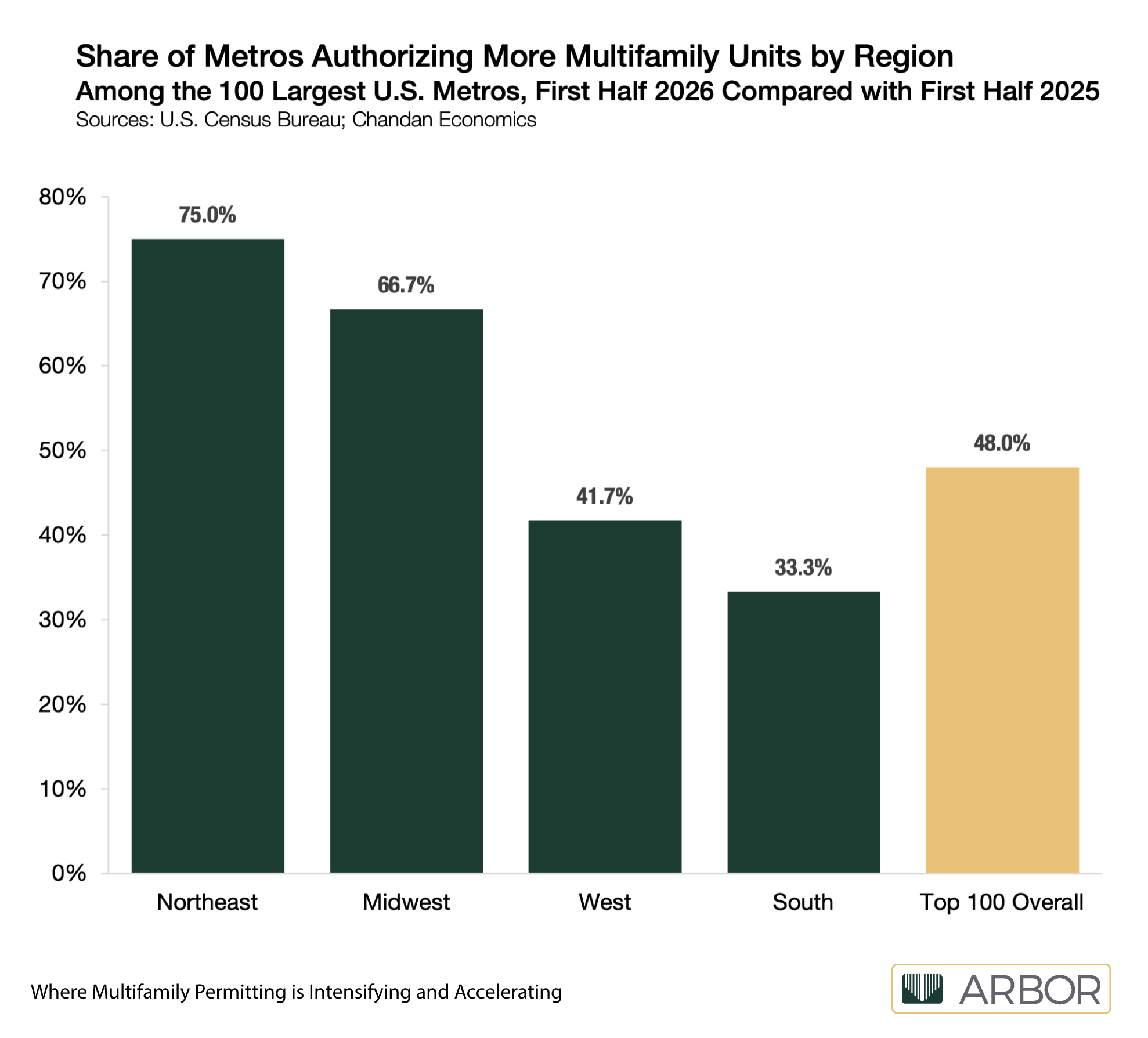
Among the 100 largest U.S. metros, only 33.3% of Southern markets authorized more multifamily units in the first half of 2026 than in the same period a year earlier, the lowest share of any U.S. region.
By comparison, permitting increased in 75.0% of Northeast metros and 66.7% of Midwest metros.
Within the South, however, the Carolinas were a major exception.
Six of the 14 Southern metros that recorded positive year-over-year permitting growth were in North or South Carolina.
This concentration of planned development activity reinforces the reality that regions with healthy local fundamentals are also considered attractive places to invest.
Smaller Markets are Playing a Larger Role
The Carolinas reflect a broader national shift in multifamily development toward smaller metropolitan areas.
Seven of the eight leading U.S. markets for multifamily permitting intensity had populations below 1.5 million, with Raleigh as the only exception.
That pattern suggests developers are increasingly looking beyond the country's largest metros and responding more directly to local population growth, employment conditions, housing demand, and market-specific development opportunities.
For investors and developers, the trend underscores the importance of evaluating the fundamentals of individual metros rather than relying only on broad regional performance.
The Takeaway
The Carolinas, already an attractive place to live, are on the cusp of a new wave of growth.
At a time when multifamily activity is increasingly selective, the Carolinas demonstrate how strong demographic and economic fundamentals can continue supporting new supply even as development slows elsewhere.
For more multifamily insights and research, visit Arbor.com and Traded.co.