

May 13, 2026
Beyond Southern Florida: Emerging Multifamily Markets for Senior Renters

Traded Editorial
Key Points
- Senior renters are increasingly bypassing gateway cities in favor of smaller, more affordable metropolitan areas that offer a better balance of cost, livability, and access to services.
- Secondary markets in the Southeast and Mountain West are meeting senior renter demand through a combination of walkable urban cores, lower tax burdens, and lifestyle advantages.
- The shift toward emerging multifamily markets reflects a structural change in senior housing demand, favoring affordability and livability over scale and prestige.
Senior renters are redefining retirement geography. Rather than focusing exclusively on major coastal metros or traditional Sun Belt hubs, older multifamily renters are increasingly choosing to live in smaller, more affordable cities with urban conveniences.
According to Arbor Realty Trust and Chandan Economics, more than half of senior renter households now live in multifamily housing, and they have become more interested in living in secondary metropolitan markets across the Southeast and Mountain West. The shift reflects changing priorities among retirees, who are placing greater emphasis on affordability, healthcare access, walkability, and overall quality of life.
Established vs. Emerging Markets: What the Comparisons Reveal
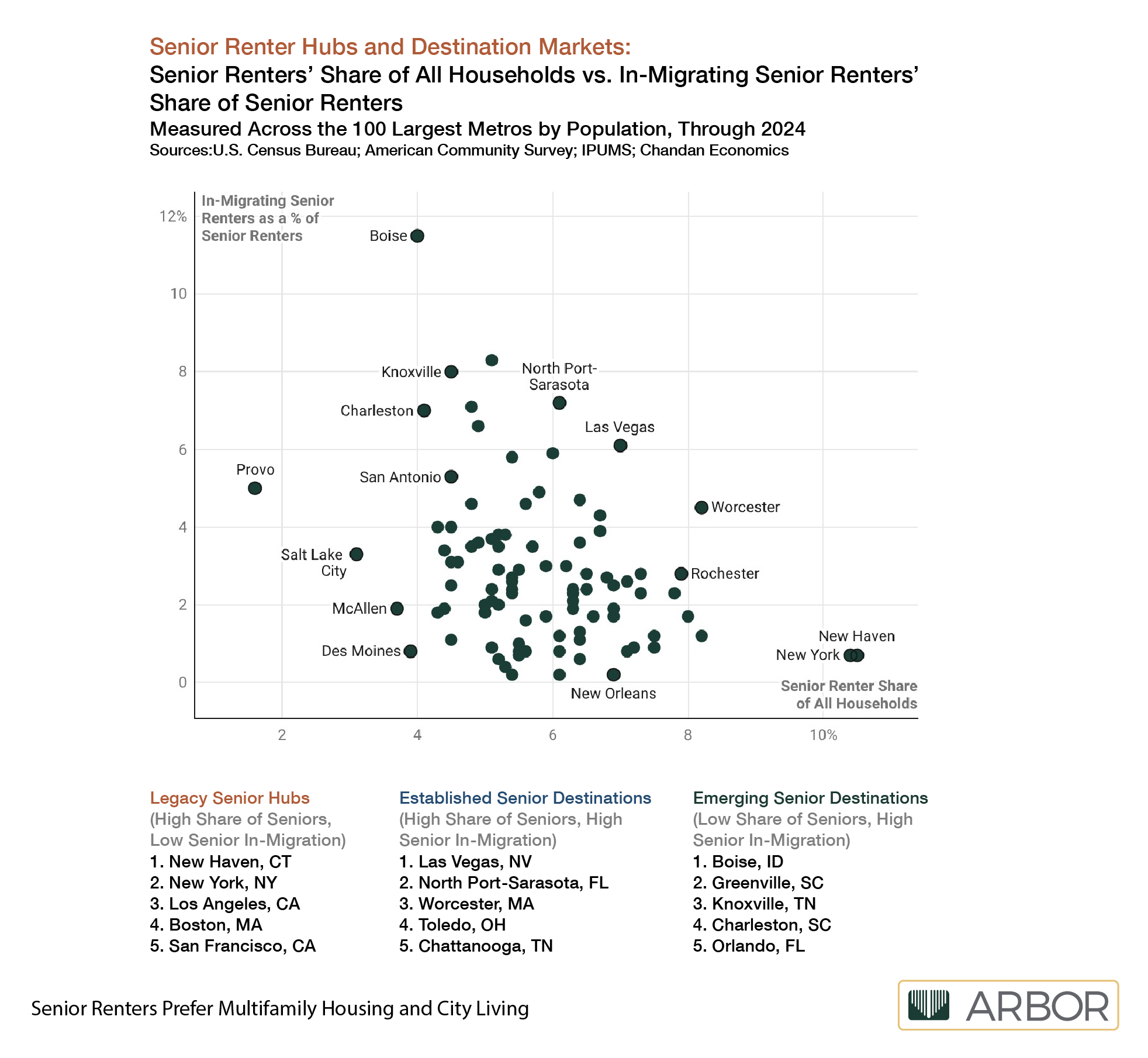
The contrast between established gateway metros and emerging secondary cities illustrates how senior renters are recalibrating what they value most in retirement. Los Angeles offers extensive healthcare networks and cultural depth, but rents rank among the highest in the country, and traffic imposes real quality-of-life costs. Boise, by contrast, offers easier access to outdoor recreation, lower-density neighborhoods, and multifamily housing options that provide significantly more value for retirees living on fixed incomes.
New York and Knoxville present a similar contrast. New York's healthcare infrastructure and transit connectivity are difficult to replicate, but the premium required to live there is increasingly difficult to justify for seniors no longer tied to the city's employment base. Knoxville has developed a walkable downtown environment with convenient access to healthcare providers, retail corridors, and daily services, offering many of the practical advantages of larger cities without the same cost burden or congestion.
Boston and Greenville extend the pattern. Boston's medical institutions are among the most respected in the country, but housing costs and the broader cost of living place considerable strain on retirees with limited income flexibility. Greenville, South Carolina, combines a revitalized downtown district with a milder climate, lower housing costs, and a more favorable tax environment than many Northeastern markets, making it increasingly attractive to retirees seeking affordability without sacrificing accessibility or lifestyle.
Why Are More Seniors Retiring in Secondary Cities?
Three primary factors are driving senior renter migration toward secondary cities: urban convenience, cost efficiency, and lifestyle advantages.
Secondary cities have invested heavily in walkable downtown districts that place healthcare, retail, dining, and essential services within close reach. In markets like Knoxville, seniors can maintain an urban lifestyle without the density, traffic, and pace associated with larger coastal metros. For retirees no longer tied to employment centers, that balance has become increasingly attractive.
Cost efficiency is the most direct driver. Senior renters on fixed incomes face a structural disadvantage in gateway cities where rents have risen considerably over the past decade. Emerging markets across the Southeast and Mountain West combine lower rents with reduced state and local tax burdens, allowing retirees to stretch fixed incomes further. In many cases, seniors can secure newer multifamily housing with better amenities at a substantially lower cost than in gateway cities.
Lifestyle and climate round out the picture. The Carolinas and Tennessee offer milder winters, while markets like Boise provide active seniors with access to outdoor recreation and a slower pace of daily life. For many retirees, these quality-of-life considerations now carry as much importance as proximity to traditional economic centers.
Senior Renters Favor Affordability and Livability
The growing appeal of secondary cities among senior renters points to a broader structural shift in multifamily housing demand. Arbor Realty Trust and Chandan Economics' new research makes this visible, separating legacy senior hubs like New York and Boston, where senior populations are established but in-migration has slowed, from emerging destinations like Boise, Greenville, and Knoxville, where in-migration rates rank among the highest across the 100 largest metros. The question for multifamily investors is no longer whether this shift is real but which emerging markets are best positioned to accommodate sustained senior renter demand in the years ahead.
For more multifamily news and insights, visit Arbor.com and Traded.co.