

May 29, 2026
Why Balance is the Differentiator of the Moment in Multifamily Market Selection

Traded Editorial
Key Points
- Arbor Realty Trust and Chandan Economics' Spring 2026 Top Markets for Multifamily Investment Report identified a widening gap between markets with well-rounded fundamentals and those built on a single competitive strength.
-
Markets where a combination of labor conditions, rent levels, affordability, and supply pipelines are all working together produce more consistent investor outcomes than markets where one factor carries the load.
-
Indianapolis, Nashville, and Milwaukee ranked among the top-performing metros in the report, with occupancy and rent stability that broader market pressures have not disrupted.
Why Market Selection Is Taking on Greater Weight
As the multifamily sector moves from a period of elevated supply and interest rate pressure toward greater stability, where capital gets deployed matters more than it did a few years ago.
In 2026, the most attractive multifamily markets are not necessarily the fastest-growing ones. They are where several fundamentals support one another, giving investments more ways to grow.
Arbor Realty Trust and Chandan Economics' Spring 2026 Top Markets for Multifamily Investment Report evaluated 25 variables across 10 categories to identify the most attractive large metros for multifamily investment this spring. The top-performing markets shared a clear pattern: they were not leading in any single metric but remained consistently strong across several categories.
For many markets, the rental housing supply surge is largely in the rearview and rents are once again growing across most markets. At the same time, job growth has cooled, population growth is expected to slow, and competition for renters is increasing. In that environment, investors are placing greater emphasis on metros that can sustain performance across multiple economic conditions rather than relying on rapid rent growth or temporary demand spikes.
The Growing Divergence Between Markets
Sound labor markets, sustainable rent levels, relative affordability, strong demand indicators, and manageable supply pipelines helped top metros remain stable while other markets softened under broader economic pressure.
Midwestern markets performed particularly well. Indianapolis was the overall leader, while Milwaukee and Chicago both ranked within the top 10. Cincinnati, Columbus, and Kansas City also remained firmly in the upper tier, supported by affordability, stable labor conditions, and durable renter demand.
One-dimensional markets are facing a different reality. When a market's primary advantage, whether rapid rent growth, aggressive supply absorption, or concentrated hiring in one industry, begins to weaken, the investment thesis often weakens with it. The report's findings showed that markets lacking balance became more exposed as operating conditions normalized.
As a result, investors are increasingly prioritizing markets where multiple fundamentals support long-term stability instead of chasing the fastest-growing metro in a single cycle.
Multidimensional Markets: Indianapolis, Nashville, and Milwaukee
Indianapolis
Indianapolis ranked first in Arbor's Spring 2026 Multifamily Opportunity Matrix, driven by a 7.9 percentage point increase in rental occupancy during 2025 and 30 consecutive months of above-average rent performance, according to the report.
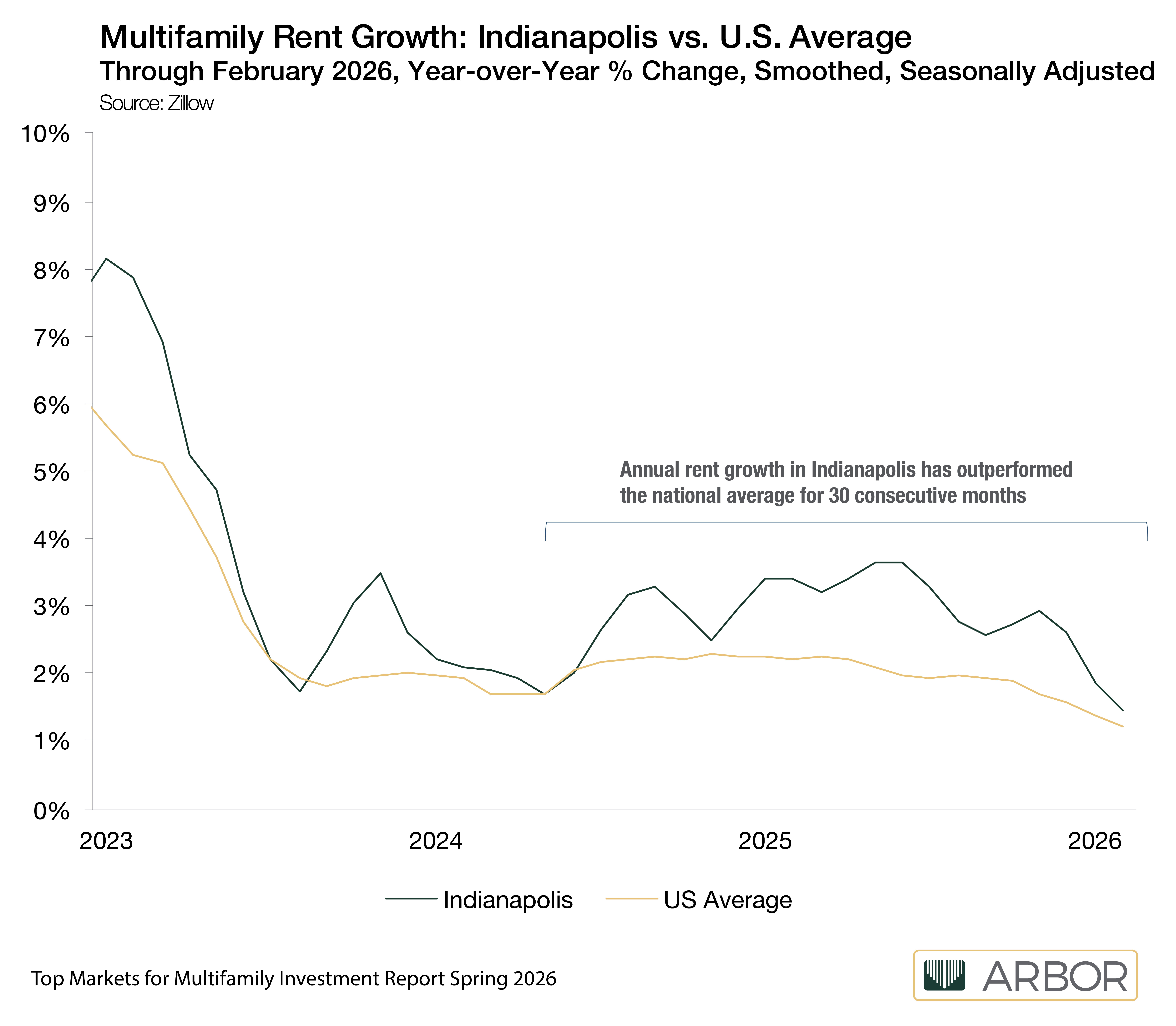
The market's strength comes from balance rather than outsized growth. Employment across healthcare, logistics, advanced manufacturing, and life sciences has supported household formation without the volatility that can come from dependence on one sector.
Affordability also is one its major differentiators. Compared to many coastal markets, Indianapolis is relatively affordable yet still maintains strong occupancy and steady leasing conditions. Combined with a measured supply pipeline, the metro has become one of the more stable multifamily markets in the U.S.
Nashville
Nashville maintained a top tier position on the strength of its labor market and renter demand indicators.
The market continues to benefit from population inflows, expanding employment in healthcare, technology, and business services, and a relatively young renter base. Nashville was also among the country's leading absorption markets, maintaining leasing momentum despite elevated construction activity. Through the combination of demand strength and economic diversification, Nashville has remained resilient even as broader market conditions normalize.
Milwaukee
Milwaukee is another consistent performer, supported by stable occupancy, relative affordability, and durable renter demand.
Like several other Midwest metros, Milwaukee has benefited from diversified employment across healthcare, logistics, and manufacturing sectors. Renter demand has kept pace with new supply even as the pipeline has remained active, a sign that the market's fundamentals are absorbing inventory without meaningful disruption.
Although it receives less national attention than larger growth markets, Milwaukee's balanced fundamentals have made it increasingly attractive to investors seeking income durability and downside protection.
Market-Based Strategies Gain Traction
For investors deploying capital in 2026, market selection is one of the more controllable decisions in a period when interest rates and broader economic conditions remain uncertain.
Markets like Indianapolis, Nashville, and Milwaukee offer steady occupancy, durable employment bases, and relative affordability that can support consistent returns without relying on outsized growth.
The markets best positioned for this cycle are not necessarily the fastest growing or best known. They are the ones where fundamentals remain aligned across multiple dimensions and where the investment case does not rely on any single factor staying favorable.
In the current cycle, strategic market selection, not just asset selection, is becoming one of the defining factors for multifamily performance.