
Nov 7, 2024
What's the Deal? | Jared White of Quadrum Global on Developing The Huron

Traded Editorial
What drew you to purchase the land that would subsequently become the Huron?
Quadrum Global bought the site at 29 Huron Street just over a decade ago, in July of 2014. At first, we weren’t too keen to build condos; we merely saw the deal as a land banking play. The Greenpoint waterfront was rezoned from industrial to residential in 2005, and we knew the land value would significantly increase. The zoning board’s master plan included 50 acres of parks, open space, and thousands of residential units. Then, the Great Recession paused all development. Fast forward to 2013, nothing new had been constructed in Greenpoint, and the city’s vision was far from complete. Williamsburg was growing rampantly at this point, and as Greenpoint has dynamics similar to Williamsburg's, we felt there was an opportunity to capitalize on this growth. Greenpoint had low crime, superb restaurants and was becoming a much more desirable place to live. By 2018, 21 India was being constructed on the waterfront, which tipped our thesis's scale. Now developing the land ourselves was very compelling. 21 India has hundreds of rental apartments, and the top 95 units are condos, which sell incredibly well. We moved forward in building for-sale condos on our site and decided the project name would be The Huron, a nod to the street and our prominent waterfront position.
What sets The Huron apart?
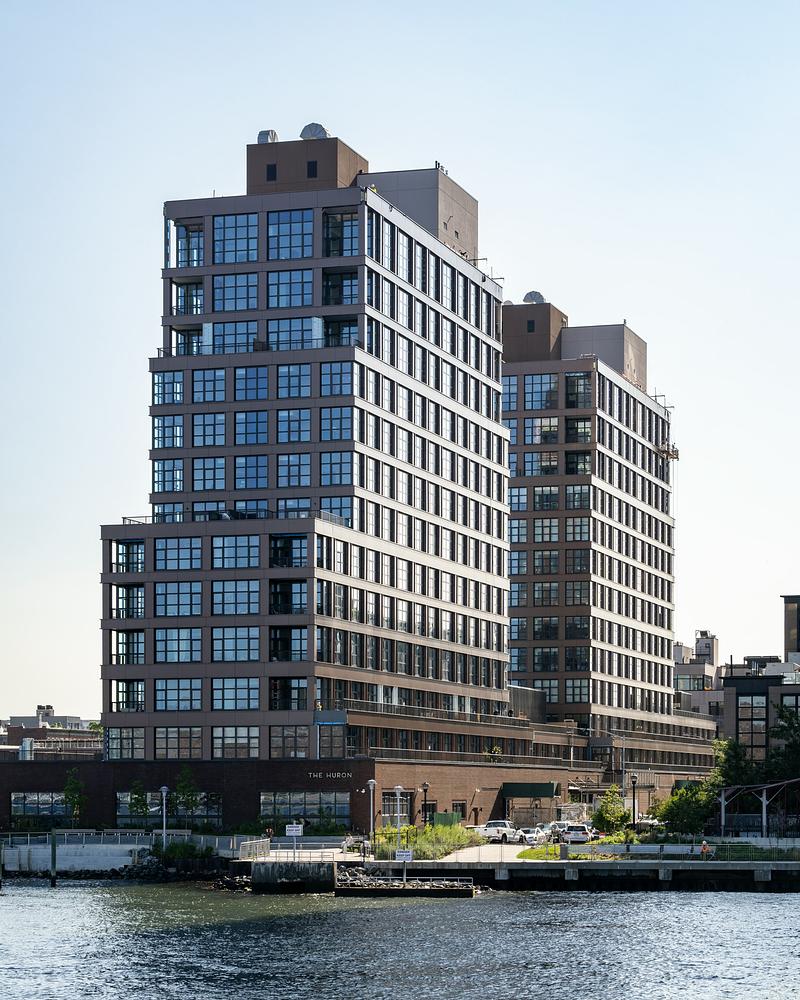
The Huron’s two-tower massing maximizes the number of corner and penthouse units we could offer, and we have over 23,000 square feet of private outdoor space. The design by Morris Adjmi enables permanent waterfront and skyline views of New York City, the East River, Brooklyn, and Queens, which is a dream for most New Yorkers. Our amenity package is also a standout attraction. Boutique buildings at this scale typically do not accommodate the quantity/quality of amenities that The Huron offers. We have a roof deck on each tower, an outdoor treehouse playground with mature landscaping, a saltwater pool, sauna, fitness center, yoga studio, coworking spaces, lounges, etc. There is ample room for owners to host dinner parties and entertain and we appealed to all age groups. The teen lounge with vintage arcade games is a hit. Quadrum hosts events for the residents, and there is a true sense of community in the building. It’s been rewarding to see organic friendships form and bonding in these spaces that we painstakingly developed. The Huron was also featured on Ryan Serhant’s hit show “Owning Manhattan,” which solidified our name-brand recognition in the market.
How did you finance the deal?
Quadrum Global had a JV partner who brought us the deal, and we paid all of the cash. Financing is very risky in land banking. We paid $45 million without debt and bought out our JV partner shortly after the acquisition. We tried to sell the building in 2017 when we listed the property and were even under contract for about a year. Over the course of that year our intentions changed and we began to have sellers' remorse as our neighbors found success in their development project. On both the purchase and sale of real estate, it takes a long time to go through due diligence, hire a broker, and on land sales deals specifically to create a vision for the property that you feel comfortable executing. In the end, it all worked out, and we’re very happy, but given the demand and our strong pace of sales, including record price-per-square for sponsor units in Greenpoint, I do wish we had more inventory! We achieved over $2,600 per square foot for a seventh-floor residence and have a Penthouse in contract for nearly $6 million. We have a couple of Penthouse level two and three-bedroom residences available which are garnering a lot of attention, so we’re hopeful to continue to see strong pricing as we sell the last remaining units in the building.
What was the process of designing the building and working with Morris Adjmi?
Morris Adjmi and his whole team are fantastic. Morris is exemplary at his craft and he’s also an amazing human being. We are fans of his proficiency at building contextually. He can make a building look like it’s been there for 100 years in the best possible way. Morris studied the history of Greenpoint and pulled from its heyday as a bustling waterfront industrial hub. We learned so much. Greenpoint once had the largest pencil factory in the nation and during the Civil War, Greenpoint had a shipyard that built the first-ever iron-hulled ship for the Union. This was a huge technological feat. That ship was in the Battle of Hampton Roads in Virginia. The silhouette of The Huron looks like two smoke stacks on a ship. Additionally, we have a very skinny lot, only 665 feet wide and 100 feet deep. To maximize space, Morris came up with this multi-tower vision.
How did you get your start in real estate?
I worked in real estate out of college in 2008. After the financial crisis hit, I transitioned to law school. I graduated, passed the Bar, and still hold my license, although I don’t currently practice. About two years after I graduated law school I decided to join NYU’s real estate program. NYU’s program opened the door for me to work at Quadrum Global, a London-based investment and development firm that had a small operation in the United States at the time with only a handful of people. They were looking for someone young who had a variety of skills, which made my law degree quite useful. Over the last ten years, I’ve grown within the firm and we’ve continued to add new people and assets. We started as an LP in deals that were solely a capital provider but we’ve built out our own development capabilities internally, which has been pivotal for our growth. The final stage of our growth included venturing into management, so we now have investment, development, and operations capabilities within the firm. I currently oversee the firm’s acquisitions, and on specific projects, like The Huron, I oversee asset management, finance, sales, and leasing (we have commercial space in the building).
Reflecting on your journey, would you have done anything different?
It’s important to recognize that you don’t go to law school to learn how to make money; however, I wouldn’t have done it any other way. The skill set of problem-solving and critical thinking pushed me to be more intellectually curious and a more dynamic executive. I also met some of my closest friends at law school and am still friends with them to this day.
What are some industry trends that have caught your eye?
I am always interested in how asset classes “trend.” Right now, we’re seeing narrative shifts in industrial and retail. In 2022, you could sell an industrial building at a one cap; it was the hottest investment in the world. At the same time, retail fell out of favor significantly during the pandemic. Fast forward only two years; retail has been hot, and industrial has fallen out of favor. There isn’t some universal truth about asset classes; it’s about supply and demand along with local market dynamics. To continue on this theme of asset classes, we are bullish on hotels because they are inflation-protected. Quadrum Global owns Arlo Hotels, an independent and experience-driven hotel brand currently with locations in Chicago, New York, Miami, and soon to be Washington D.C. Rates on hotels change daily, which prevents us from being locked into long-term leases and losing out on the potential for rate increases that you might be subject to during a 10-year industrial lease. Another massive indicator of hotel success is the strength of the US dollar. The stronger the dollar, the less international travel there is and those are factors you don’t have to consider when investing in other asset classes.
One final point on asset classes and market-specific trends is that New York’s residential sector has been historically under-supplied. That’s not to say that rents never go down because they do occasionally. The housing stock is old compared to other cities, significantly growing areas like the sunbelt. If you can properly execute a business plan for apartments in New York City, then you’re in great shape.