

Jul 7, 2026
The Full Stack: Behind Naoshi Matsumoto's Vision for Sunland Group
Sunland Group founder Naoshi Matsumoto has built a vertically integrated development firm spanning architecture, construction, and lending, and is now targeting Miami’s Belmar waterfront with luxury residence Casa Vanda.

Traded Editorial
Miami's luxury waterfront market has no shortage of developers chasing the next hot neighborhood. Naoshi Matsumoto has built his career on getting there first, and on controlling nearly every discipline required to build once he does.
The Chilean businessman founded Sunland Group in 2015 after building an executive career across finance, manufacturing, hospitality, transportation, automotive, and mining, while also serving on the boards of companies including PC Factory, Grupo Security, and Travel Security. That range, he says, is what pulled him toward development in the first place.
"Real estate development became a natural extension of that experience because it combines many of the disciplines I enjoy most: finance, design, construction, and entrepreneurship," Matsumoto says.
What he built with that background is unusual for a firm Sunland’s size: a fully in-house platform spanning development, architecture, construction, brokerage, and private lending. By keeping development, architecture, construction, brokerage, and lending under one roof, the firm maintains control over nearly every stage of a project.
Betting on Neighborhoods Before the Comps Catch Up
Sunland's playbook in South Florida has been to move into waterfront neighborhoods before the broader market prices them in. One of the firm's earliest projects was in Old Cutler Bay, a waterfront pocket of Coral Gables, where Sunland set what was then the highest residential sale in the neighborhood.
"That project helped unlock the potential of that market," Matsumoto says.
The firm ran the same play in Belle Meade, a waterfront community near Biscayne Bay, again setting a neighborhood sale record.
"We were among the first developers to recognize the neighborhood's long-term potential," he says. "That helped pave the way for many new developers who now operate there."
Internationally, Matsumoto has overseen the Zoco mixed-use developments in Santiago, Chile. Coordinating residential, commercial, hospitality, retail, and cultural components across multiple stakeholders strengthened Sunland's ability to execute large-scale, multi-asset developments.
Across the portfolio, Matsumoto has been a majority investor as well as the executive driving delivery. To date, Sunland has developed more than 2 million square feet of residential and mixed-use projects, representing over $700 million in total investment value.
Casa Vanda: The Newest Bet on Belmar
Sunland's latest project applies that same early-mover logic to Belmar, a waterfront pocket of Miami the firm is actively investing in.
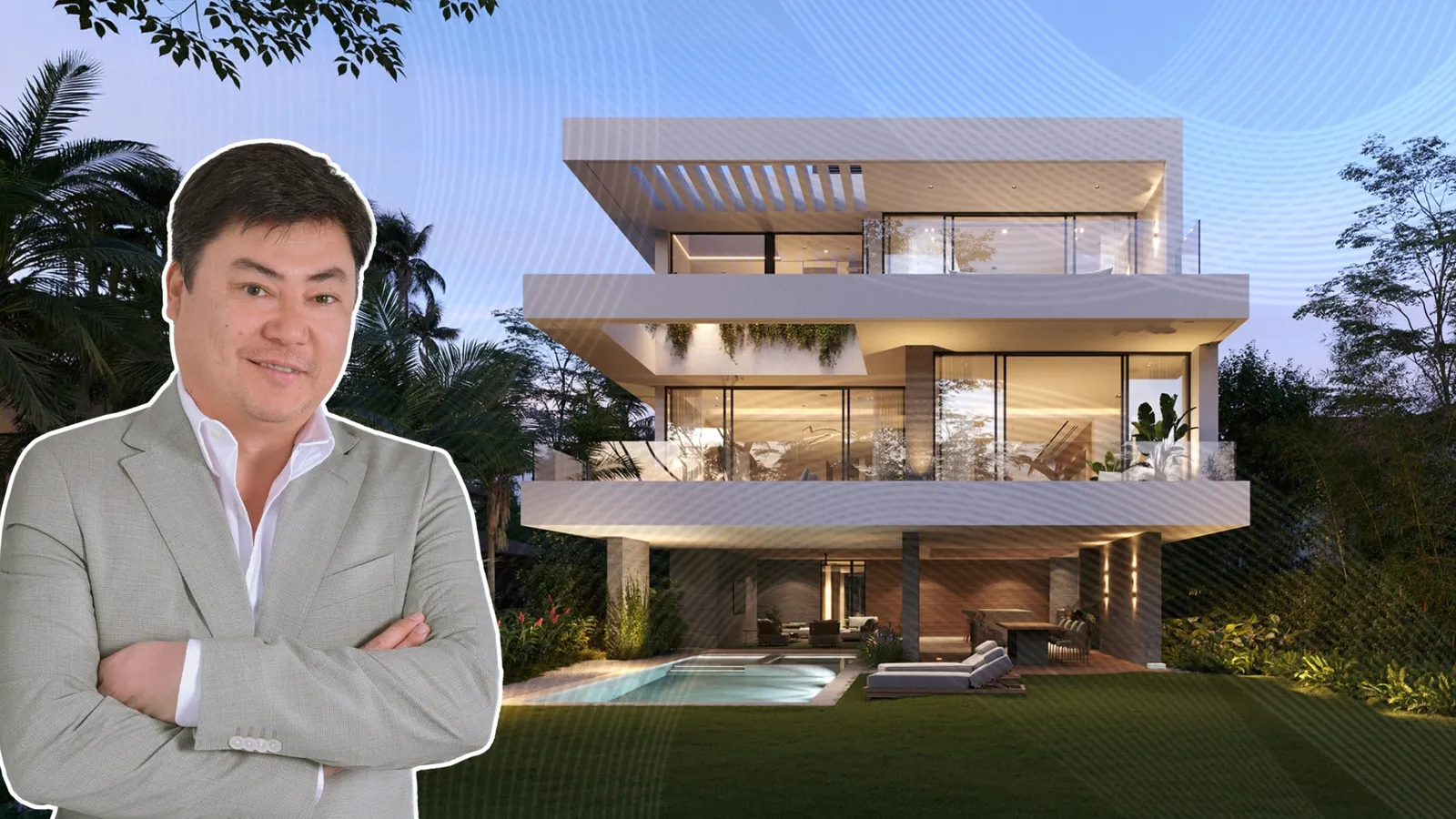
Casa Vanda is a three-story residence built around Tropical Modernism: exposed concrete walls, warm natural materials, and integrated planters designed to blur the line between the architecture and the canal it sits on. Terraces and balconies open directly onto the water, with indoor-outdoor living spaces built around what Matsumoto describes as a "constant dialogue" between water, landscape, and architecture.
"Luxury today is about more than finishes and amenities," he says. "It is about creating spaces that feel connected to their environment, enhance everyday living, and offer a timeless architectural experience."
Why Sunland Doesn't Outsource
Ask Matsumoto why Sunland built out development, architecture, construction, brokerage, and lending internally instead of running asset-light, and the answer comes back to control.
"We wanted complete control over the vision, execution, and quality of every project," he says. "When all of the key disciplines are working together under one roof, decisions can be made more efficiently, communication improves, and the original vision for a project is preserved from acquisition through final delivery."
In a market where construction costs, labor availability, and supply chains remain unpredictable, Matsumoto argues that owning the construction arm outright, rather than contracting it out, is one of the more durable advantages a developer can have, particularly on a highly customized project like Casa Vanda.
"It gives us greater visibility and control over budgeting, procurement, scheduling, and execution," he says.
He's aware that plenty of developers make the opposite bet, staying asset-light and leaning on third-party contractors. For Sunland, he sees the full-stack model as a moat, not overhead.
"We believe our vertically integrated approach becomes even more valuable" as buyers grow more sophisticated, he says. "It allows us to move with greater speed, maintain higher standards, and create a more consistent experience from acquisition through final sale."
The Harder Part Was Culture, Not Org Charts
Creating the platform was one challenge. Building a culture around it proved to be another. According to Matsumoto, getting architects, builders, brokers, and lenders to operate as one organization instead of five separate ones took longer than assembling the disciplines in the first place.
"The greatest challenge was assembling the right team and creating a culture where professionals from different disciplines operate as a single organization rather than separate departments," he says.
The payoff is consistency. Whether Sunland is building a custom waterfront residence or a larger institutional development, the firm operates under the same standards while benefiting from faster decision-making, greater accountability, and less reliance on outside partners who may not have the full picture of a project.
Grounded Outside the Job
Matsumoto's résumé outside Sunland is dense: board seats at SK Comercial, SK Rental Group, Modyo, and Godelius; president of the Ganbaru Foundation; director of the Chile Dual Foundation; an adviser to TECHO; a former competitive athlete on Chile's National Athletics Team who went on to serve as a director of the Chilean Olympic Committee. Off the clock, he breeds horses, not for competition, but for what's known as rational taming, a method of gentling horses without physical force.
Asked how he balances all of it, he points to faith and family first, and to delegation second.
"I've been fortunate to build strong teams around me, and empowering talented people allows me to focus on both my professional responsibilities and my personal priorities," he says.
What He'd Tell Someone Starting Out
Matsumoto's advice to developers earlier in their careers is to resist specializing too soon.
"The best developers understand finance, construction, design, operations, marketing, and leadership," he says. "Real estate is ultimately a people business, and opportunities often come from trust earned over many years."
"If your goal is simply to complete transactions, your impact will always be limited," he adds. "If your goal is to improve communities while creating sustainable value, your work has the potential to outlive your career."
That philosophy explains why Sunland was built as a full-stack developer rather than a traditional one. For Matsumoto, controlling the process is not simply about efficiency. It is about protecting the original vision from acquisition through completion and creating projects designed to outlast the market cycle that produced them.
"We are not simply developing buildings," he says. "We are creating places that people will experience every day for generations."