

Aug 25, 2026
Small Multifamily’s Stability Shines Brightly
Small multifamily fundamentals held steady in Q2 2026, with cap rates at 6.0%, occupancy at 96.3%, and originations tracking to a $71.6 billion annualized pace, underscoring a market shifting from repricing to normalizat…


Traded Editorial
Key Points
- Small multifamily asset valuations continued to broadly stabilize in Q2 2026.
- Cap rates held steady at 6.0% as historically narrow Treasury spreads limited major pricing movements.
- Occupancy firmly held at 96.3%, supporting durable property-level fundamentals.
- Lending activity remained healthy, with originations reaching a $71.6 billion annualized pace through the first half of 2026.
The small multifamily sector is demonstrating strong fundamentals and resilience, after several years of rapid interest-rate changes, shifting valuations, and changing capital availability.
Data from Arbor Realty Trust and Chandan Economics’ latest Small Multifamily Investment Trends Report shows that this commercial real estate sector is now characterized by relatively stable pricing, occupancy, and leverage alongside healthy lending activity. Its defining feature through the first half of 2026 is not rapid growth or another major repricing cycle. Instead, the sector is displaying increasing stability across both property fundamentals and capital-market indicators.
The Factors Supporting Small Multifamily’s Equilibrium
Valuations: Broadly Stable
Small multifamily property values remained steady in the second quarter, extending a prevailing pattern that began in early 2024. The Arbor Small Multifamily Price Index registered declines of just 0.8% quarter-over-quarter and 0.3% year-over-year.
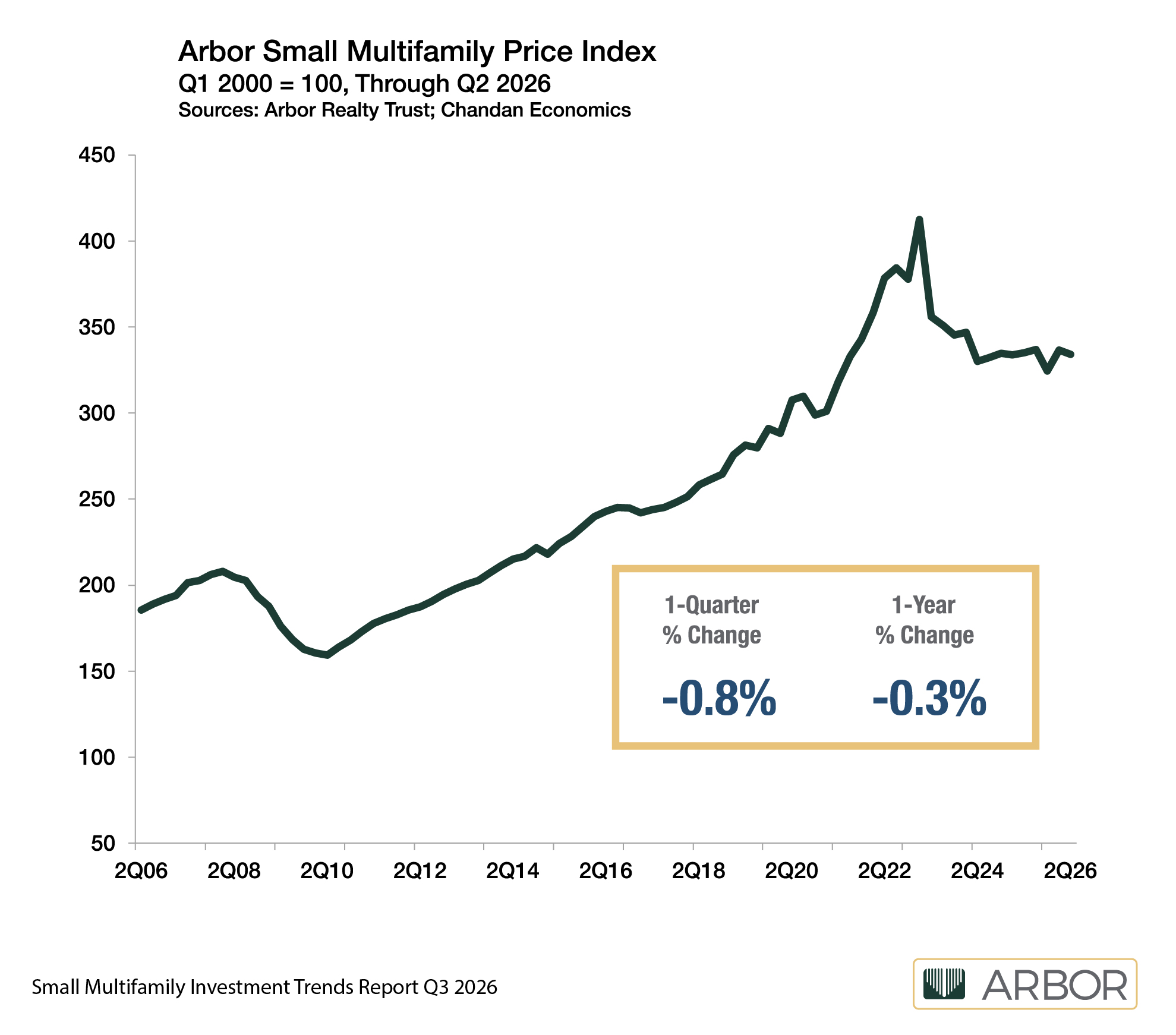
Modestly stronger net operating income (NOI) helped support values as occupancy held steady, rents edged higher, and expense ratios eased, while a rise in cap rate pared some of those gains. The result is a pricing environment that remains largely unchanged rather than one experiencing a renewed repricing cycle.
Cap Rates: Stable
Average small multifamily cap rates increased to 6.0% in Q2 from 5.8% in the previous quarter, remaining within the relatively narrow range seen since early 2024. Acquisition and refinance cap rates rose to 6.2% and 5.9%, respectively.
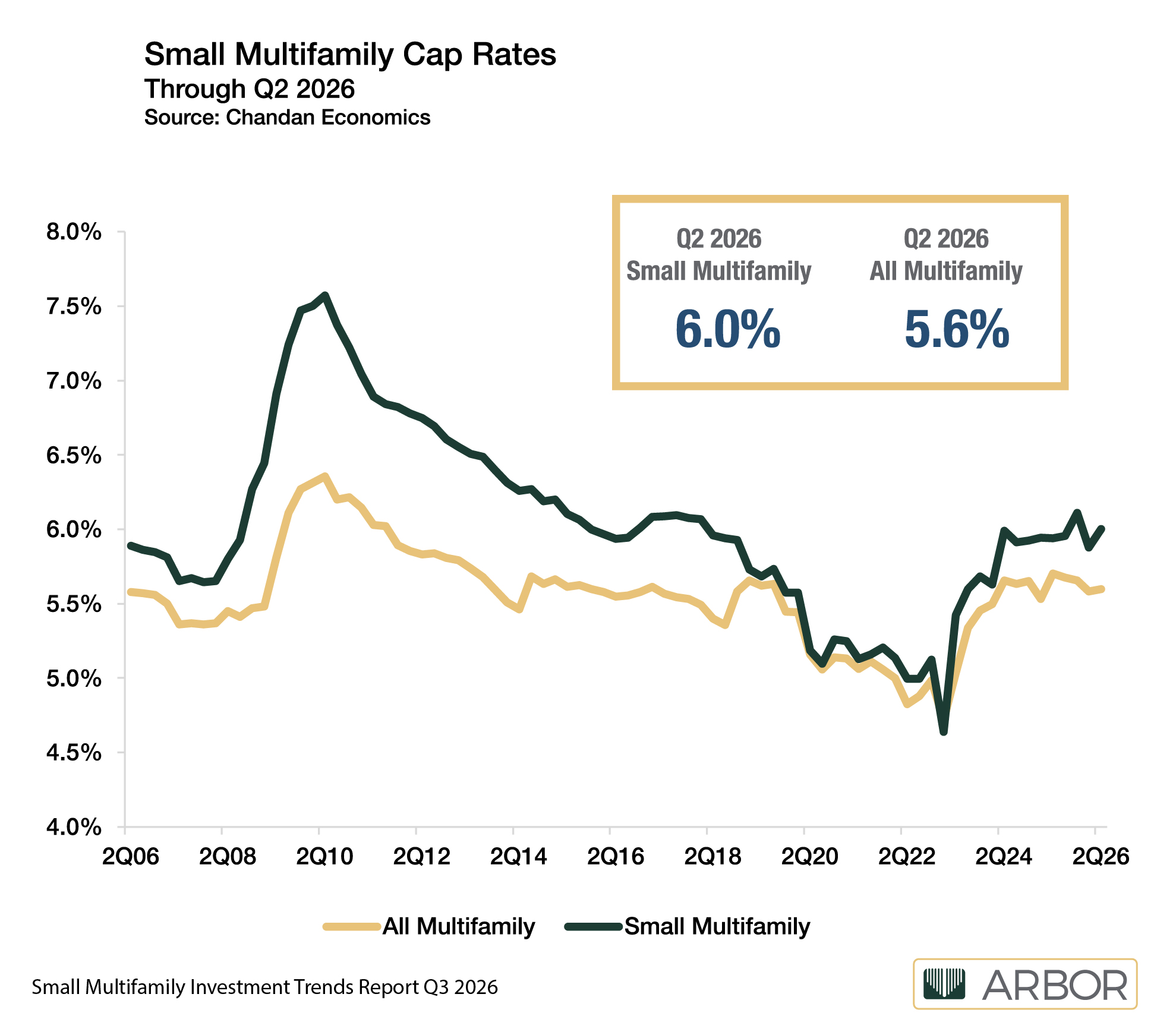
At the same time, the small multifamily risk premium relative to the 10-year Treasury was relatively steady, ending the quarter at 158 basis points (bps). With spreads still historically narrow, research from Arbor Realty Trust and Chandan Economics finds there is limited room for substantial cap rate compression or rapid valuation acceleration under current conditions.
Occupancy: Stable
Occupancy at financed small multifamily properties remained effectively unchanged at 96.3%. Although slightly below Q2 2025 levels, occupancy rates have stabilized after softening in late 2025.
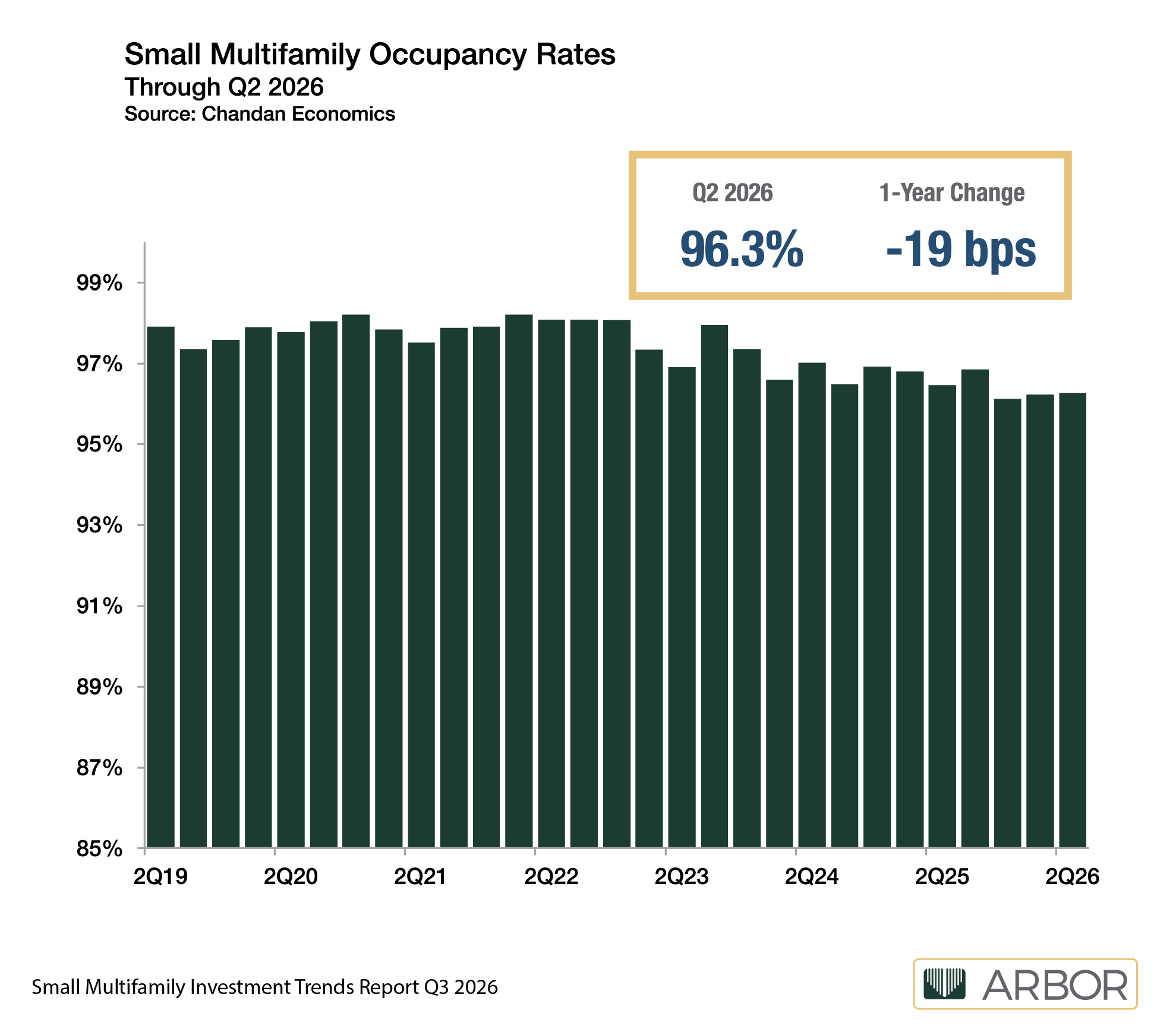
The asset class also continued to outperform the broader national rental market, which had a 92.7% occupancy rate. That resilience is an important source of support for property cash flows and reinforces the sector's stable operating backdrop.
Originations: Healthy
Small multifamily lending activity continued at a strong pace even with elevated borrowing costs and selective capital availability. At a pace to reach $71.6 billion by year-end, originations were 2.8% above last year’s total of $69.6 billion.
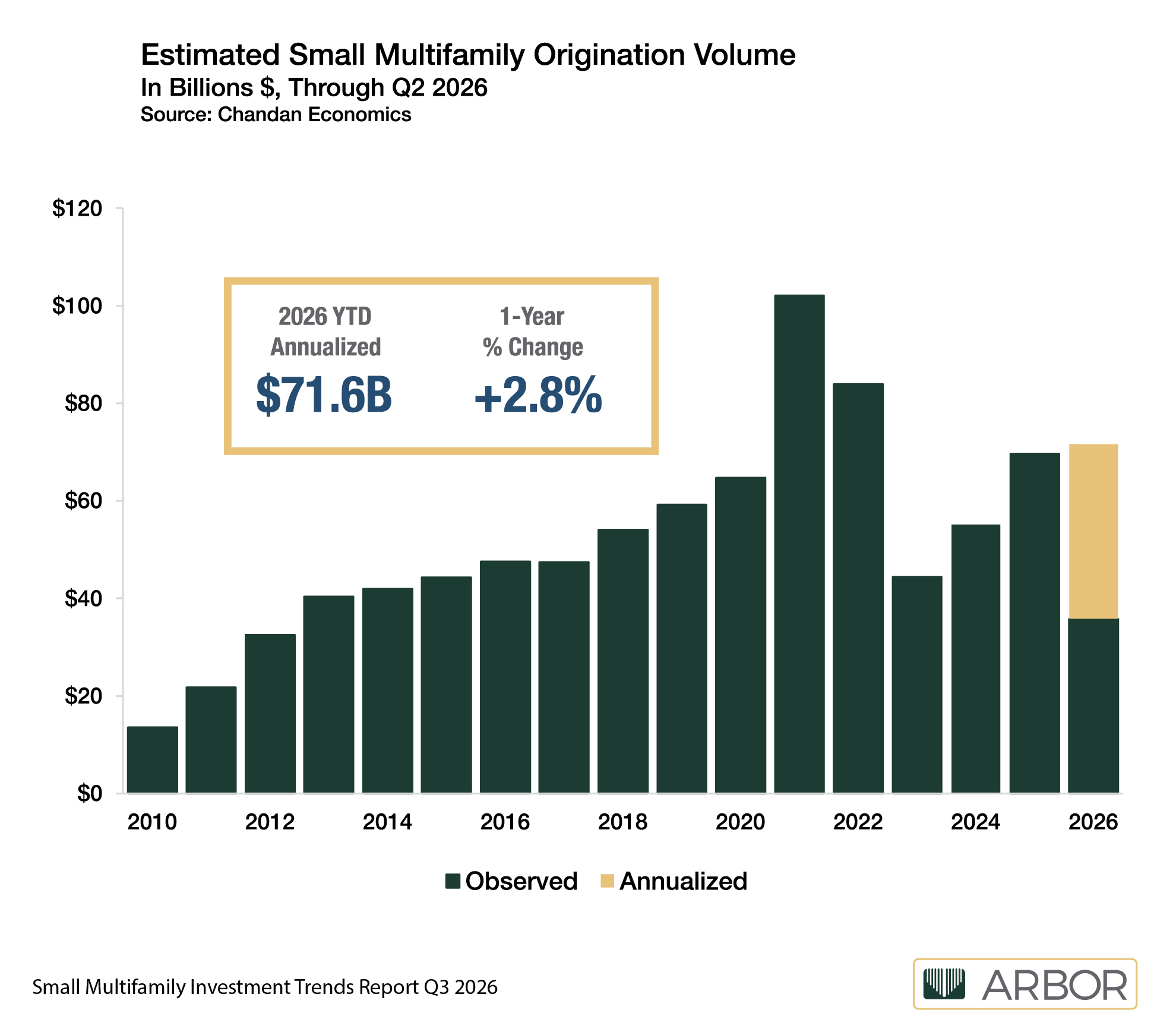
Refinancings represented 65.0% of Q2 originations as loan maturities continued to drive demand. While market conditions, such as interest-rate volatility, may be influencing discretionary financing decisions, overall activity remained stable.
Why Small Multifamily's Stability is a Big Deal
Small multifamily has begun transitioning from repricing to normalization. The market remains active and evolving without the extreme fluctuations that characterized prior cycles.
Stability, however, is not to be confused with stagnation:
- Originations are growing.
- NOI improved modestly.
- Occupancy remains high.
- Financing remains available.
After years in which investors and borrowers were forced to react to the ups and downs of a volatile market, predictability provides new value. It gives market participants a more reliable foundation for underwriting acquisitions, managing existing assets, and planning refinancings.
If current trends hold, small multifamily's next chapter may be defined less by dramatic swings and more by normalization and steady growth.