

Jul 24, 2026
Regional Trends in Multifamily Property Sizes Reveal Areas of Opportunity

Traded Editorial
Key Points
- The national shift toward larger, lower-rise multifamily properties continued in 2025, even as total completions moderated from their 2024 peak.
- Regional differences in land availability, zoning, construction costs, population growth, and existing supply shape how that trend appears in individual markets.
- Regional development patterns create different opportunities and risks, making market selection and disciplined underwriting especially important.
A national shift toward larger, lower-rise properties is reshaping multifamily development, though its effects are not uniform. Localized differences in land availability, population growth, construction costs, zoning, approval timelines, and existing supply are creating region-specific investment conditions, and the same national trend can carry different implications depending on where capital is deployed.
What the Data Shows
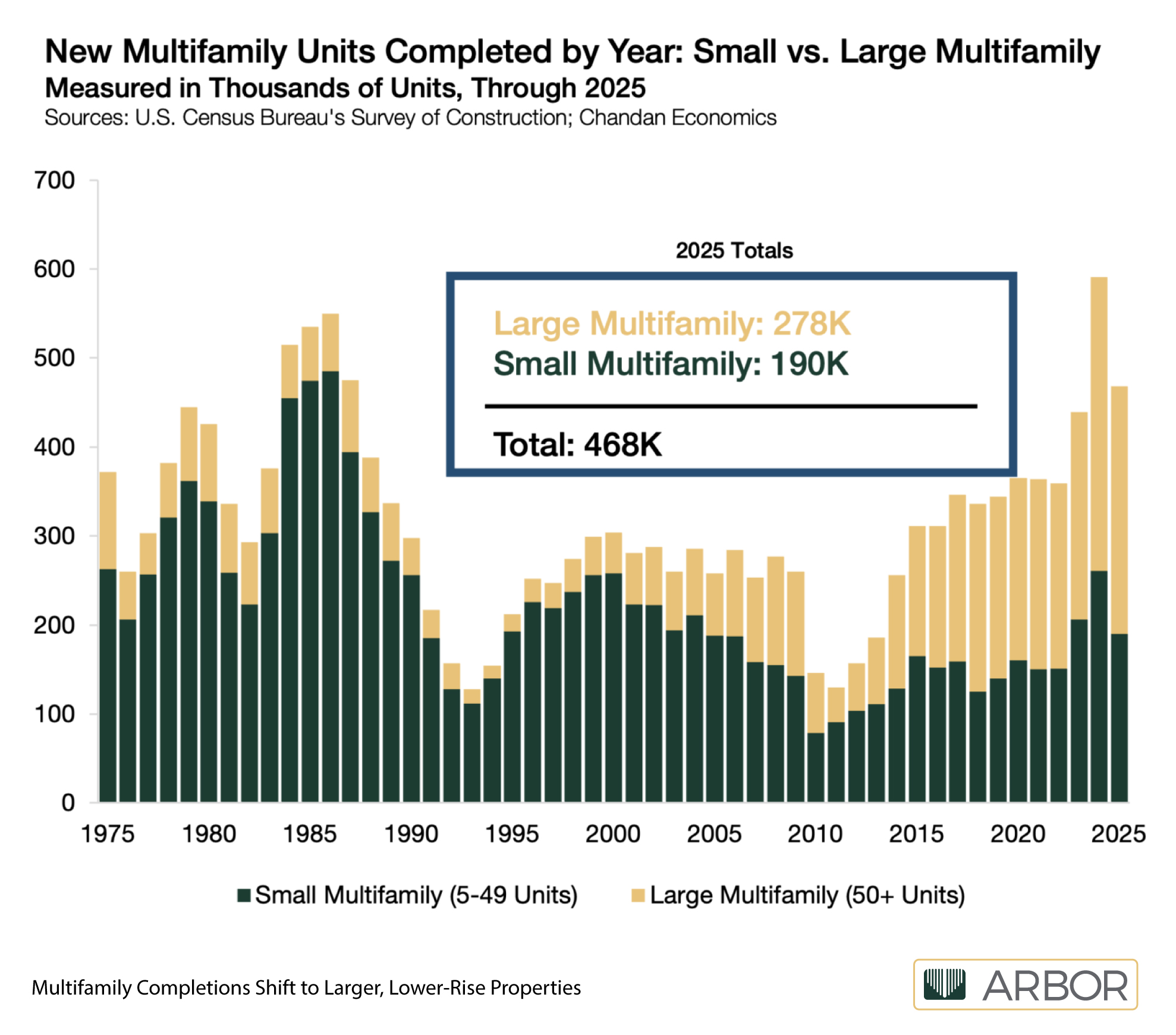
Multifamily completions moderated in 2025 after reaching a historic high the prior year. According to Chandan Economics and Arbor Realty Trust’s analysis of the U.S. Census Bureau’s annual Survey of Construction, completions across properties with five or more units declined from 591,000 units in 2024 to 468,000 units in 2025.
The slowdown was more pronounced among smaller properties. Completions in buildings with five to 49 units fell 27.2% to 190,000 units, while completions in properties with 50 or more units declined 15.8% to 278,000 units. Even with the pullback, large-property completions remained above every annual total recorded before 2023, indicating historically elevated production is normalizing.
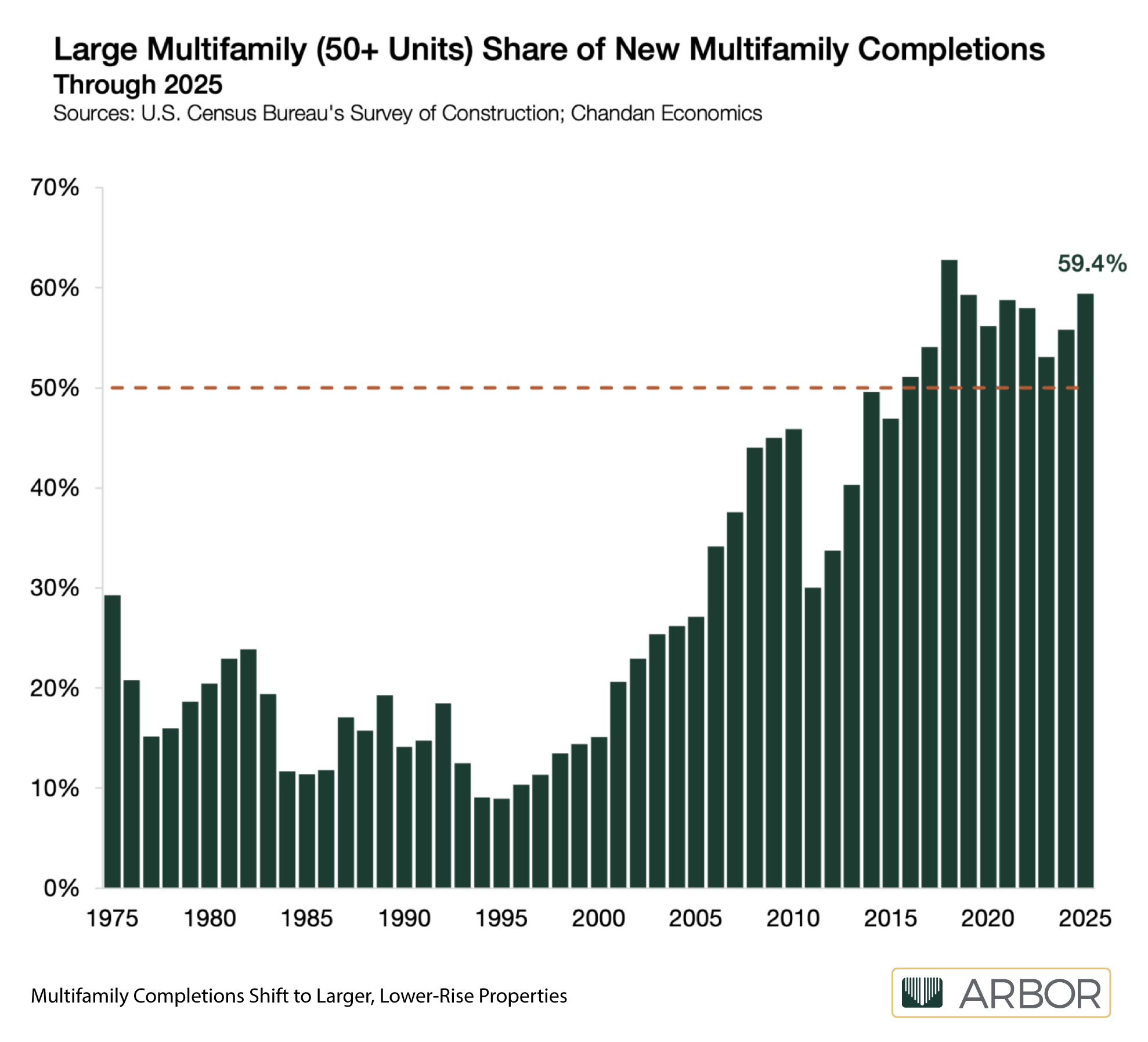
New supply continued to shift toward larger properties. Buildings with 50 or more units accounted for 59.4% of all multifamily units completed in 2025, up from 55.8% one year earlier, and the second highest share recorded in 50 years. Before 2016, large properties had never represented a majority of annual completions, and since then, they have accounted for more than half every year.
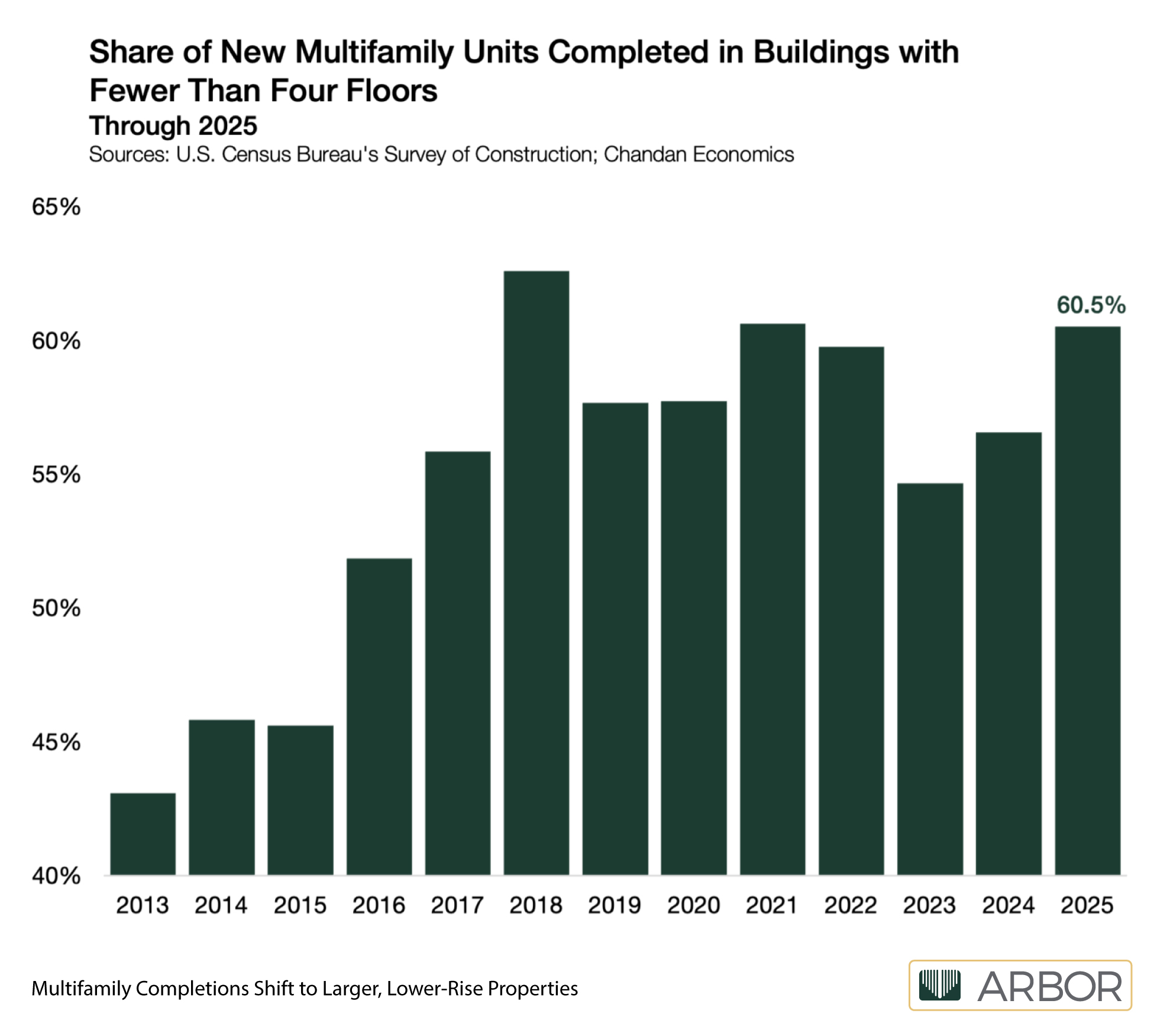
Larger, however, has not necessarily meant taller. The Arbor report finds that 60.5% of completed units in 2025 were in buildings with fewer than four floors, up from 56.6% one year earlier, consistent with the lower-rise supply trend. Unit sizes have edged up as well, with 49.6% of completed units carrying more than one bedroom, compared with 47.0% a year earlier.
The report notes that these patterns may also reflect the financial realities of development. Arbor’s analysis notes that larger projects may offer economies of scale, while smaller developers often face greater barriers involving up-front capital, financing access, and project risk. Because land, zoning, and approval conditions vary by region, those economics produce different development and investment outcomes.
The Midwest: Lower Costs and Selective Growth
Lower land and operating costs are supporting lower-rise development across many Midwest markets. In areas where sites are less expensive and approvals move more predictably, developers are facing less pressure to build at the density required to justify high project costs. For investors, that can translate to a lower acquisition cost than are typically available in coastal markets.
Those conditions can support moderate construction activity, more stable supply-and-demand conditions in selected markets, and potentially stronger cash yields. In areas where development pipelines remain limited, existing properties are also facing less competition from new deliveries.
These constraints are largely demographic. Population and household growth are generally more moderate than in the South, which may reduce the scale of new construction and leave performance more dependent on local conditions. Employment expansion can be uneven across metros, transaction liquidity is often thinner in smaller markets, and results may hinge on a narrow set of industries or employers.
As a result, market selection may carry more weight. Investors should prioritize metros with diversified employment, positive household formation, and limited competing supply. Lower acquisition costs can be attractive, but they hold up only where local fundamentals are durable.
The Northeast and Coastal West: Constrained Supply and Higher Barriers
The Northeast and Coastal West face a different development environment. Expensive land, restrictive zoning, lengthy approval processes, and elevated construction costs can limit the amount of new multifamily supply that reaches the market.
In areas where development does move forward, scale may help spread land, entitlement, financing, and construction costs across more units. That national shift toward larger properties is especially relevant in high-cost markets, where scale may help spread land, entitlement, financing, and construction costs across more units. The share represented by larger properties was the second-highest recorded in 50 years.
For investors evaluating Boston, New Jersey, and other high-barrier locations, development constraints can support durable occupancy and reduce the risk of competing deliveries. Existing properties may benefit when new projects are difficult to finance, approve, or construct.
Those advantages come with meaningful costs. Acquisition prices are often higher, regulatory requirements can be more complex, and taxes, insurance, labor, and other operating expenses may place pressure on returns. Investors must also consider rent regulation in certain jurisdictions and the greater reliance on high-cost construction formats.
Supply constraints, rather than rapid population growth alone, are often a primary investment advantage in these markets. Strong barriers to entry can provide operating stability, but investors must carefully evaluate costs, regulation, and expense growth at the state, municipal, and submarket levels.
The Sun Belt and Mountain West: Growth at Scale and Its Trade-Offs
Population growth, suburban expansion, and available land have supported large garden-style development throughout many Sun Belt and Mountain West markets. These regions contain substantial pools of recently built properties with modern amenities and newer housing stock.
This regional development pattern also reflects the lower-rise component of the broader national trend. In 2025, 60.5% of completed multifamily units nationwide were in buildings with fewer than four floors, up from 56.6% one year earlier. The sustained role of lower-rise construction shows how developers can add substantial rental supply without relying exclusively on high-rise formats.
In Texas and other Sun Belt markets, periods of slower lease-up may create opportunities to acquire newer assets below replacement cost. Investors with a long-term outlook may be able to access properties in growing markets at more attractive pricing when near-term operating performance weakens.
The same development activity can also create risk. Concentrated construction pipelines may increase competition among similar properties, extend lease-up periods, and place short-term pressure on rents. Properties delivered within the same cycle may compete for the same renter base by offering similar pricing, concessions, and amenity packages.
Investors should remain conservative when underwriting rent growth, concessions, occupancy, and stabilization timelines. Attractive long-term population and employment fundamentals do not eliminate the effects of near-term supply pressure.
The Takeaway
The shift toward larger, lower-rise multifamily properties is national, but its impact is local. For investors, this trend highlights the need for regionally focused strategies.
The most attractive investments may be found where acquisition pricing reflects near-term risk, durable local fundamentals support rental demand, competing supply is manageable, and financing terms align with a realistic operating plan.