

Aug 29, 2023
Novak is Back: The 40-acre, $40M Home Where Djokovic Stays for the US Open
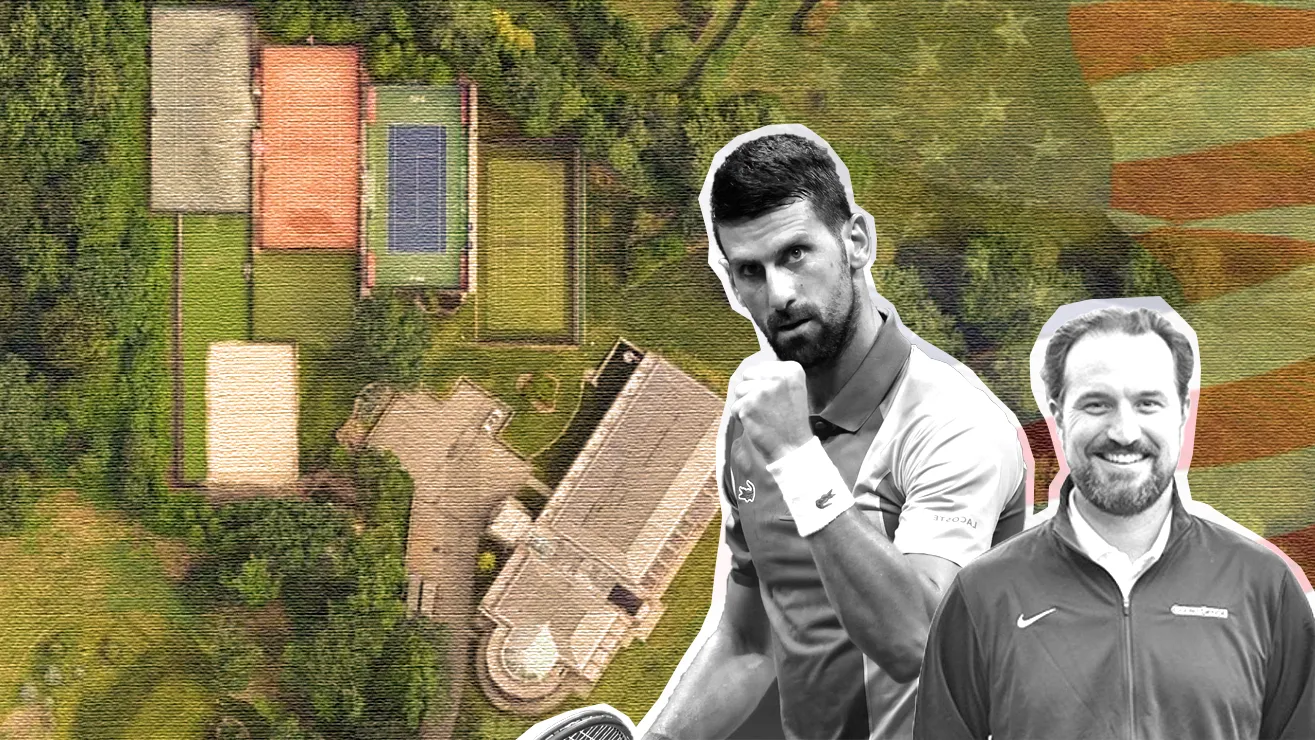
In Alpine, located in northern New Jersey, behind imposing gates on an unmarked driveway lies an estate encompassing 48 acres of grandeur, valued at a staggering forty million dollars. This remarkable property, replete w…

Traded Editorial
In Alpine, located in northern New Jersey, behind imposing gates on an unmarked driveway lies an estate encompassing 48 acres of grandeur, valued at a staggering forty million dollars. This remarkable property, replete with imposing residences, numerous auxiliary structures, a human-made lake, picturesque gardens, and breathtaking vistas, was meticulously curated by Robert Zoellner and his partner, Victoria. Together, they co-founded Alpine Associates Advisors, a specialized firm focusing on merger arbitrage. While Zoellner, who sadly passed away last year, harbored a keen interest in tennis, it is his son, Gordon A. Uehling III, who has embarked on an ambitious venture to transform a hillside section of the estate into a cutting-edge tennis training facility.
What makes this project unique: Uehling's facility harnesses digital technology to comprehensively gather data on every facet of a player's physicality, mentality, and performance. Employing state-of-the-art tools, this facility aims to enhance a player's performance significantly. For several years now, Novak Djokovic, the world's preeminent tennis player, has made this estate his training ground.
Uehling, a close and informal member of Djokovic's support team, has played a pivotal role in introducing Djokovic to groundbreaking technologies such as the cvac hyperbaric chamber. Djokovic affectionately refers to Uehling as "Super G," a moniker inscribed on an autographed photograph displayed proudly on the wall of one of two tennis clubs in nearby suburban towns. These clubs, an extension of Uehling's academy known as CourtSense, serve as platforms for disseminating his innovative concepts concerning tennis and physical fitness.
How this facility came to be: Uehling once harbored dreams of a professional tennis career. His journey as a player left him with a profound curiosity about player development. He discerned that, at the elite level, technical prowess and power were nearly ubiquitous, but what set the best players apart was their ability to endure and excel, both physically and mentally. Recognizing tennis as an area lagging behind in terms of technological advancement, Uehling noted that scientific breakthroughs primarily pertained to racket and string materials. Unlike baseball, tennis lacked the kind of analytics pioneered by Bill James. Uehling emphasizes the enduring importance of individual coaching, while advocating for the complementary role of technology as an additional set of discerning eyes.
He contends that technology can amass data beyond the scope of human coaches, providing concrete evidence to guide players toward improvement. He envisions that technology-savvy younger generations will demand such data-driven insights, which can also track development trends over time.
The cutting edge technology: Uehling's Alpine training facility boasts a diverse array of tennis courts, including green-clay Har-Tru, DecoTurf hard, red-clay reminiscent of Stade Roland Garros in Paris, and an upcoming grass court. However, the centerpiece resides indoors within a low-profile brick field house—a cutting-edge hard court equipped with a camera-and-software system developed by PlaySight. Aptly named the PlaySight Smart Court, this technological marvel records every stroke, movement, and action of a player. It can instantaneously signal whether a shot is in or out, following predefined guidelines from the coach. Metrics such as ball speed, spin, trajectory, point patterns, distance covered, and calories expended are meticulously logged. All this information is readily accessible on a courtside touch-screen kiosk, facilitating real-time analysis by coaches and players from various angles. Moreover, this data is stored and can be dissected to uncover player tendencies and growth patterns over extend