

Interviews
Jul 13, 2026
Jasper Wu on Building ZD Jasper Realty From a Four-Person Office Into a 25-Building Long Island City Platform
ZD Jasper is a family-run development firm based in Great Neck, Long Island, with an in-house construction arm and a growing footprint across Queens and Manhattan.

Traded Media
Traded Editorial
6 min read
"People send you deals, people give you money, because they think you can deliver your product on time and execute your business plan."
That's how Jasper Wu, Vice President and Principal at ZD Jasper Realty, explains the currency his firm has spent nearly a decade building in New York City. ZD Jasper is a family-run development firm based in Great Neck, Long Island, with an in-house construction arm and a growing footprint across Queens and Manhattan. Since delivering its first project in 2019, the firm has completed 13 buildings, has six more under construction, and has another six in the pipeline.
From a Family Holding Company to a New York City Developer
ZD Jasper was founded by Wu's father in 1996, though the firm's early history had little to do with New York real estate. For most of the 2000s, the business was focused on development in China. Wu's father exited that business in the mid-2010s and began building in New York around 2016 and 2017, starting with 5 Court Square in Long Island City, completed in 2019.
Wu joined the firm in 2019, shortly after business school, at a moment when the company was still finding its footing.
"When I graduated from business school, I was probably employee number four," he said. "Nobody knew who ZD Jasper was at that point. Everybody was using their own Gmail accounts, Hotmail accounts. We were transferring files with USB drives."
Since then, the firm has grown to roughly 25 employees. Its projects have grown too: early buildings ran 60 to 70 units, while current projects average closer to 100 units, with the firm's largest projects to date now approaching several hundred units.
An Unlikely Path Into the Family Business
Wu's own route to real estate wasn't a straight line. He studied computer science as an undergraduate, spent time at EY after graduating, and then landed a summer internship with the NBA, a job tied to his real passion at the time: basketball. He was offered a full-time role afterward and turned it down to join his father's business instead.
"My dad gave me a lot of good points about why I should be doing this," Wu said. "It's a good platform. I'd be getting higher-level exposure joining the family business than I would working my way up a corporate ladder. He said it's a very interesting business, you get to meet all sorts of people."
Wu holds an MBA from Columbia Business School, a CFA charter earned during his time at EY, and a general contractor's license, the last of which he says gets far more daily use than the CFA.
"The GC license is something I use every day," he said. "The CFA, not so much. It's kind of overkill for the math real estate actually requires."
The Case for Building In-House
ZD Jasper's construction arm is central to how Wu thinks about the firm's edge. Early projects were built with outside general contractors, an approach that worked but came with friction, he says, vertical integration eliminates.
"Sometimes the developer's interest and the GC's interest aren't always aligned, and that slows projects down," Wu said. "For the GC, it doesn't matter so much if a project is a month or two late. For the developer, it matters immensely."
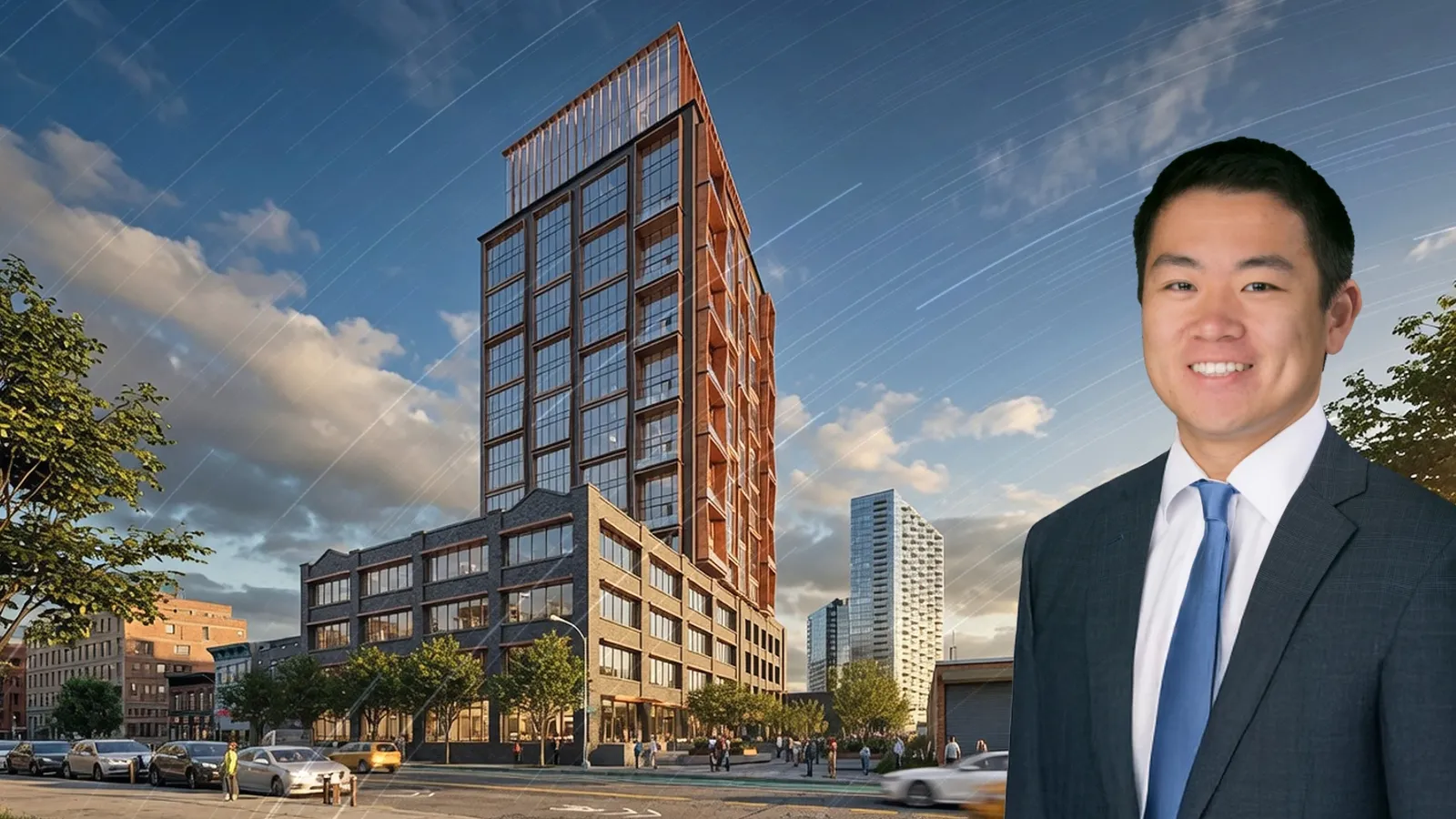
The payoff shows up in the schedule. Wu pointed to Paragon, the firm's project at 45-40 Vernon Boulevard in Long Island City, as an example: a project he says would typically take a market-rate developer three to four years is on pace to be completed in about 24 months, roughly a 50% reduction in timeline.
Inside the Paragon Deal
Paragon has become something of a signature project for the firm, not because it was simple, but because it wasn't. The site carried brownfield issues and a zoning variance from the Board of Standards and Appeals, rather than as-of-right entitlements; complexity Wu says, kept other bidders away.
"There was a lot of uncertainty around how much you could actually change: floor plans, layouts, how much you could tweak it to fit the market," he said.
ZD Jasper paid $47 million for the site, a basis Wu describes as favorable specifically because of that complexity, and leaned on a team that included former seller Quadrum Global, a zoning attorney from what is now HSK Kramer, and Brooklyn-based architecture firm Archimaera.
The project preserves the facade of a former factory on the site, with original support columns repurposed as design elements inside finished units. It's also structured as a condominium, a deliberate bet on an underserved part of the Long Island City waterfront market.
"All the product along the waterfront are rentals," Wu said. "We thought there would be huge demand from families who want a more permanent home and had nowhere to turn."
As part of the project, ZD Jasper is building more than 15,000 square feet of public waterfront park space at its own cost, to be maintained at the sponsor’s cost, with retail activations along the promenade.
"We'll be the first one there," Wu said, "and everyone in the future is going to connect to our park."
Staying Consistent Through Cycles
Wu describes ZD Jasper's underwriting philosophy as intentionally unresponsive to short-term rate movements.
"It doesn't change too much whether rates are high or low," he said. "We're constantly looking for deals. If the deal makes sense, we'll pursue it. If it doesn't, we won't."
That discipline was tested during COVID, when in-person showings and utility hookups were largely unavailable and much of the market paused. ZD Jasper kept moving.
"There were deals where we could have retraded, renegotiated, but we chose not to," Wu said. "We had confidence in our product, our ability to execute, and the New York City market."
Buildings launched during that period, he said, sold out roughly a year later.
On underwriting downside risk, Wu says the firm keeps its assumptions conservative rather than speculative.
"We don't underwrite future events," he said. "We underwrite rents as they are today. Beyond that, the real downside is just your interest reserve."
What's Next for ZD Jasper
Wu doesn't frame the firm's next chapter around a specific unit count or project total. Instead, he points to scale, systems, and a possible new vertical. Projects are trending larger, and Wu says a 200-, 300-, or even 400-unit building wouldn't be a surprise. Internally, he'd like to modernize property management and back-office systems to match the pace of the development pipeline.
Affordable housing is also on the radar, an area Wu thinks plays to the firm's strengths in cost and schedule control, even though ZD Jasper hasn't yet built a dedicated platform for it.
"The city underwrites very expensive hard costs for affordable projects," he said. "We bring very tangible benefits there: speed, and our ability to deliver on time and at or under budget."
Asked to sum up the New York City market in 2026 in one word, Wu didn't hesitate: "Rising."
Published: Jul 13, 2026Last updated: July 16, 2026