

Oct 23, 2026
How Federal Policy Is Unlocking New Sources of Affordable Housing Financing

Traded Editorial
Key Points
- New government-sponsored enterprise (GSE) policy changes have expanded lending capacity for qualifying workforce housing.
- Fannie Mae and Freddie Mac can now invest up to a combined $4 billion annually in Low-Income Housing Tax Credit (LIHTC) properties.
- National 9% LIHTC allocations reached an estimated record $1.20 billion in 2026, up 14.4% year over year.
- A higher public welfare investment ceiling for national banks opens room for more bank capital to flow into affordable housing.
A Stronger Financing Foundation Heading Into 2027
Affordable housing development is approaching 2027 with a broader set of dedicated financing options, according to the new Affordable Housing Trends Report 2026 from Chandan Economics and Arbor Realty Trust.
Federal policy changes over the past several years, including expanded GSE support, greater LIHTC investment capacity, and higher bank investment limits, are widening the capital pool for affordable and workforce housing.
Although financing challenges remain, more channels now support projects serving middle- and low-income renters.
Affordable Units Are Gaining Share of New Supply
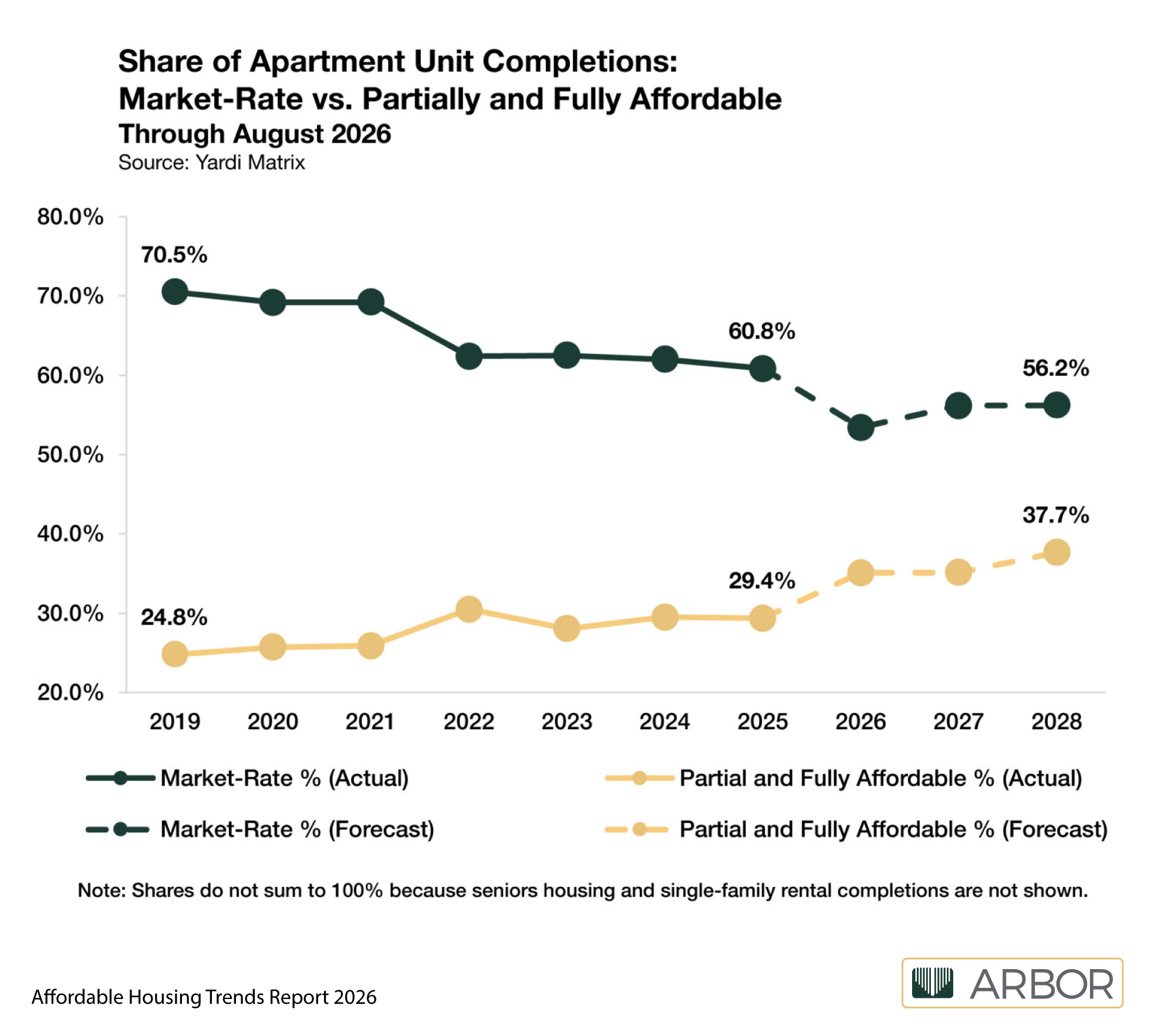
The affordable housing pipeline is gaining momentum even as the broader apartment market absorbs a recent wave of deliveries. Citing Yardi Matrix data, Arbor reports that fully and partially affordable units made up 29.4% of tracked apartment completions in 2025, a share that could reach 37.7% by 2028.
While this shift in the composition of new supply will not resolve the affordability shortage alone, persistent renter demand still provides a solid foundation for the sector's development outlook.
GSE Policy Changes Expand Lending Capacity
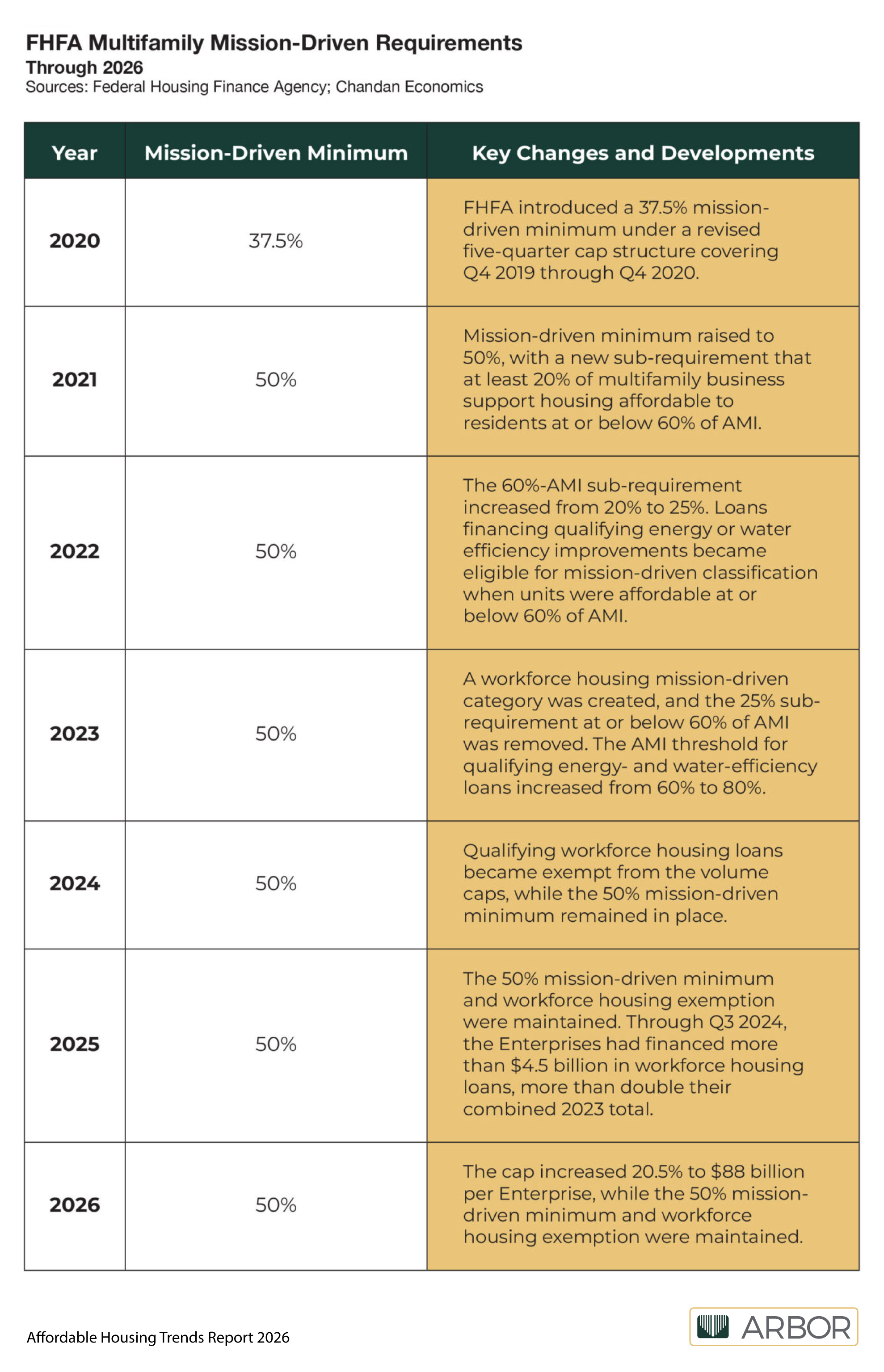
The latest installment in Arbor’s Affordable Housing Trends Report series traces the expansion of mission-driven financing to 2021, when the Federal Housing Finance Agency (FHFA) raised the minimum mission-driven share of each GSE's multifamily business from 37.5% to 50%.
In 2024, FHFA exempted qualifying workforce housing loans from GSE multifamily volume caps, creating additional room for eligible loans outside the enterprises' standard capped lending capacity.
To qualify, loans must preserve affordability through rent or income restrictions codified in the loan agreement. The added capacity is tied to documented affordability requirements, not simply a property's workforce housing designation.
Together, these policies extend financing support beyond traditional subsidized housing to properties serving middle-income renters, who are also facing affordability challenges right now.
LIHTC Expansion Strengthens the Equity Side
Debt capacity is only part of the financing equation. LIHTC remains a primary source of equity for affordable housing, and the research report identifies growth on both the investment and tax credit allocation sides.
In 2025, FHFA doubled each GSE's annual LIHTC investment limit from $1 billion to $2 billion. That gives Fannie Mae and Freddie Mac combined capacity to deploy up to $4 billion annually through LIHTC equity investments, with a portion reserved for difficult-to-serve and rural markets.
Separately, Arbor cites Novogradac's estimate that national 9% LIHTC allocations reached a record $1.20 billion in 2026, up 14.4% from 2025. The report attributes part of that growth to the 12.5% increase in annual 9% LIHTC allocation authority made permanent by the One Big Beautiful Bill Act of 2025.
The two figures measure different forms of capacity: GSE limits govern potential investment, while LIHTC allocations represent tax credit authority available to projects.
The ROAD to Housing Act Creates More Room for Bank Investment
The 21st Century ROAD to Housing Act, which became law on July 11, 2026, raised the public welfare investment ceiling for national banks from 15% to 20% of capital and surplus, while retaining regulatory oversight, Arbor’s Special Report indicates.
Public welfare investments support affordable housing and other community development activities. A higher ceiling could increase the bank capital available to qualifying projects and support additional demand for housing credits.
The law did not add LIHTC allocation authority, Arbor notes. Instead, it creates capacity for future bank investment, with its impact on affordable rental housing dependent on bank investment strategies, tax credit pricing, underwriting conditions, and the supply of financially viable projects.
The Takeaway
Expanded GSE lending capacity, greater LIHTC investment authority, and more flexibility for bank public welfare investments are giving affordable housing investors access to a broader range of capital sources than in years past.
For investors looking toward 2027, the task is to match each development's needs with the right financing channels. Partnering with a proven team like Arbor’s that understands GSE lending, LIHTC equity, and complementary funding sources can help borrowers navigate that process and identify opportunities within an increasingly supportive financing landscape.
For more affordable housing insights and research, visit Arbor.com and Traded.co.