

Jun 19, 2026
How 8VC’s Alex Kolicich Is Building a Craft Firm in an Era of Mega Funds
8VC founding partner and CIO Alex Kolicich believes AI is not overhyped, but underhyped. In a conversation with TradedVC, he explains why AI-native startups are entering the best fundraising market in history, how ventur…
Traded Media

Traded Editorial
Alex Kolicich does not believe AI is a bubble. He believes the opposite. As one of the founding partners of 8VC and the firm’s Chief Investment Officer, Kolicich has spent two decades watching venture capital consolidate, mature, and now race to absorb the largest technological shift since the advent of the cloud. Alex is steering a deliberately boutique firm through a market being reshaped by mega platforms, AI-native founders, and a liquidity bottleneck that he believes cannot last forever.
“In many ways, AI is underhyped,” Kolicich told TradedVC. “Nvidia is trading at 18 to 19 times forward earnings. That’s not a bubble. Cisco, back in the telecom days, was trading at 120, maybe 200.”
That view frames how 8VC is investing right now: more aggressively into AI-native companies, more skeptically toward legacy SaaS playbooks, and more deliberately around what Kolicich describes as a craft model for venture capital. In a wide-ranging conversation with TradedVC, Kolicich traced the throughline from his earliest days as an engineer at Google and Palantir to the firm he helps run today: a firm that splits its time between external investments and internal incubations, with a thesis that stretches from defense and biotech to the front edge of agentic AI.
From Google’s Abundance to Palantir’s Scarcity
Kolicich started his career at Google, working on the Street View and Google Checkout teams. The lesson, he says, was counterintuitive.
“Google was interesting because everyone was exceptional, but it had no scarcity. We had so many resources that, in many ways, it hurt the project.”
Checkout, despite a huge team, did not succeed. Street View, with fewer resources, was forced to be scrappy and find product-market fit. It became one of the most successful product launches in the company’s history.
“Startups in many ways thrive on that scarcity.”
That lesson sharpened at Palantir, where Kolicich joined the finance and time-series analysis team. Palantir was not Google. It could not always compete with the largest technology companies on compensation or brand alone. It had to recruit on belief.
“We had to get people to believe in the vision and sell them on the mission. You had to build a strong culture to fight against Google or Microsoft. You really had to teach people how to recruit. You have to build a cult around a shared mission.”
For Kolicich, that remains one of the defining traits of great startups: the ability to pull exceptional people into an unusually demanding mission before the outcome is obvious.
What He Looks For Now
After Palantir, Kolicich worked alongside Peter Thiel at Clarium and Mithril. Venture, he learned, is a long-feedback-loop game where lessons compound over decades.
“In public markets, you buy something today, and if you buy the right thing, it’s up 100% in a quarter. In venture, you don’t get feedback until something exists five or ten years later.”
Out of that came a short list of non-negotiables: people, market, and founder motivation. “You really have to focus on companies in areas that can be successful,” Kolicich said, referencing Warren Buffett’s idea that when a great management team meets a bad business, it is often the business that keeps its reputation intact.
The motivation filter is where he gets sharp. Early in his career, he assumed any successful exit was a good outcome. He no longer thinks that way.
“You sell one or two companies for three, four, five hundred million dollars, and you realize a lot of effort went into it. That’s not a bad outcome, but you likely didn’t return a fund. The bar in this game is much higher.”
The founder has to be willing to choose the harder path, even when the easy outcome is life-changing.
“If you’re 30 years old and Microsoft comes to you offering $100 million, you’re choosing between working 12 hours a day and neglecting your personal life, versus $100 million and an easy life. You’ve got to be a special type of person to choose the struggle over the easy life.”
And the founder has to be a magnet.
“The great startups create this sense of inevitability around them, that of course we’re going to be the winner. And when you’re going to be the winner, everybody wants to invest in you.”
Why 8VC, and Why the Eight
8VC spun out of Formation 8 in 2015. The Asia-focused partners kept Formation. Kolicich, Joe Lonsdale, and the others took the eight. But the name is also an intentional homage.
“In front of me here, I have a picture of the Traitorous Eight who started Fairchild Semiconductor,” Kolicich said. “Silicon Valley started in Mountain View. There’s a plaque commemorating it today.”
The Traitorous Eight were eight of William Shockley’s top engineers who left Shockley Semiconductor, formed Fairchild Semiconductor, and helped seed the lineage that produced Intel, Kleiner Perkins, and much of modern Silicon Valley.
“The eight in 8VC is an homage to those guys, the Traitorous Eight, who really birthed everything we have here today.”
Stewardship, Not Ownership
8VC began with a thesis called “Smart Enterprise”: vertical software that uses advanced data analytics to help businesses run themselves better. That thesis has since expanded.
“We try to identify places where the technological frontier has changed,” Kolicich said. “Big data and the cloud were great trends. Today, you can obviously say LLMs and AI are the next technological frontier. We invest in companies as early as we can that instantiate those changes and bring that technology to the real economy.”
The firm now invests across software, biotech, healthcare, deep tech, and defense. Kolicich jokes that the mandate now reads like a GDP breakdown by value-add. But what the firm refuses to become is a scaled platform machine.
“You see a lot more mega funds now. Funds raising five, eight, nine, ten, soon fifteen billion. We’ve always wanted 8VC to be more of a boutique craft firm. We don’t have an idea of ownership at 8VC. We have an idea of stewardship. You work with one of us, you work with all of us.”
That is the core of 8VC’s counter-positioning. As venture platforms scale into larger institutions, 8VC wants to stay close to the company-building layer: fewer handoffs, deeper partner involvement, and a firm model where every company has access to the full bench.
The 70/30 Split: When to Invest, When to Build
Roughly three-quarters of 8VC’s capital goes into traditional investments. The remaining quarter is used for internal incubations. The decision rule, Kolicich says, is simple.
“If you can invest in a business you’re excited about, you should always invest in it. We’re never going to compete with the investing side. We’ll only start something where the business that should exist doesn’t.”
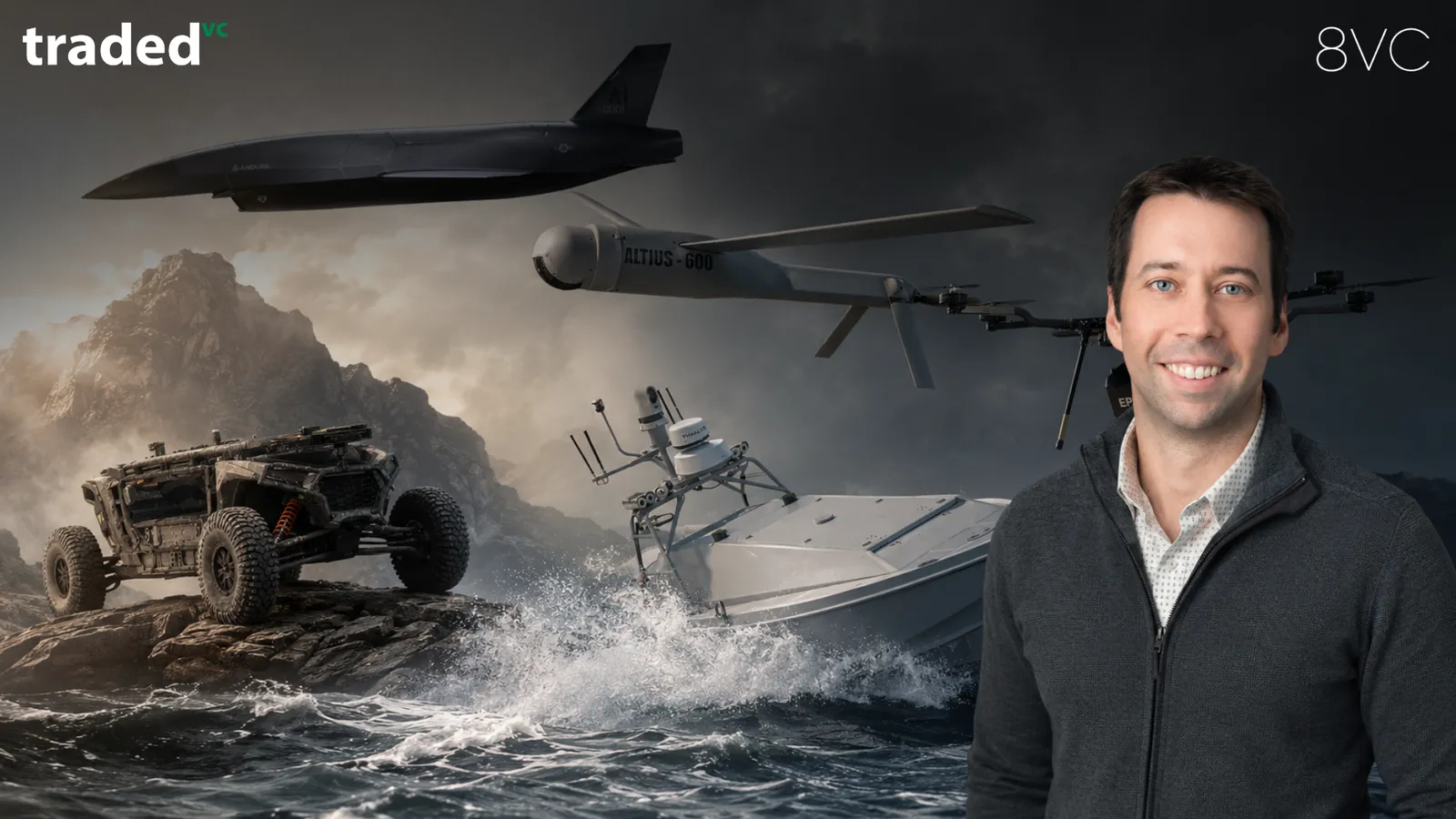
That principle has produced companies across multiple categories, including defense and biotech. One example is Saronic, which builds autonomous surface vessels for the U.S. Navy. According to Kolicich, the firm helped validate the idea, recruit early technical talent, and bring its Palantir-era playbook for working with government customers.
“A lot of early Palantir people know how to work with the government. We helped them marshal resources and get contracts. But they executed on the technology and the manufacturing. They just raised a big number. It’s one of the fastest-growing defense companies ever.”
On the biotech side, 8VC incubated a rare-disease pharmaceutical company around a contrarian observation: assets that large pharma often dismisses as too small can be highly attractive if run with the right operating model.
“Most pharmas categorize a drug doing $500M, or less, as too small. So those companies have a hard time raising money and commercializing their products. But those small drugs are usually rare-disease assets. They’re cheaper to take through trials because the FDA gives you more leeway on patient recruitment, and cheaper to commercialize.”
Kolicich sees that as an example of applying technology-style company building to categories that have historically operated under different assumptions.
“In pharma, a billion dollars is the minimum scale to be a profitable asset. From a tech perspective, there are tons of tech companies doing one, two, three, four hundred million in revenue that are profitable. And they’re way harder businesses to run.”
Where Venture Goes Next
Kolicich sees the venture market splitting in two: institutional mega platforms on one end and boutique firms on the other. He thinks both can coexist. What cannot coexist forever, in his view, is the current liquidity dynamic.
“To deploy tens of billions, the mega platforms have to keep companies private,” he said. “That deprives the industry of exits. LPs ask, when do we get more liquidity? But at the same time, they’re funding mega platforms to keep companies private. You can’t have platforms continuing to get bigger at the expense of depriving the industry of exits, because at some point the money runs out.”
That is one of the major second-order effects Kolicich believes the market still has to absorb. The same pools of capital that allow companies to stay private longer are also delaying the liquidity events that limited partners need to recycle capital back into the venture ecosystem.
What a Great Startup Looks Like in 2026
The exact AI-native company-building formula is still evolving. But Kolicich says the early patterns are becoming clearer.
“Small teams do better. Everybody is in person, working 996 in Atherton, San Francisco, or Palo Alto. You need a team that’s AI native.”
Those teams often look different from the previous generation of SaaS companies. The core is usually a group of younger, AI-native engineers paired with a smaller bench of experienced architects. The entry modality has changed as well.
“You’re not building Salesforce anymore. You’re not building old workflow software where the business logic lives inside the system. You’re building systems that help you do the work. The business logic lives in the LLM. You’re supercharging humans.”
The next phase, he believes, is agentic.
“As agents get stronger, the copilot idea is going to go away. It’ll look more like Cognition’s Devin, the first AI software engineer. The human becomes a supervisor of agents, gives them strategic direction, and the agents do the work. That’s the future modality of software.”
For founders, that means the product surface is changing. Software is moving away from systems of record and toward systems that can execute work directly. The company that wins may not be the one that owns the workflow. It may be the one that owns the agentic layer where work actually happens.
The Fundraising Split
For AI-native founders, Kolicich believes the market remains extraordinarily strong.
“If you’re AI native, it’s the best time in history to raise money.”
Legacy SaaS is a different story. Forward multiples have compressed, and Kolicich expects the pressure to continue. AI-native companies that can go from zero to four or five million in revenue inside a year are operating in a separate market from traditional software businesses trying to justify old multiples with old growth models. The implication is clear: “AI company” is no longer enough. The market is separating companies that merely attach AI to an existing workflow from companies that are structurally native to the new modality.
The Trend Nobody Is Pricing In
Asked what the market is still underestimating, Kolicich does not hesitate.
“It’s funny, it’s the standard Silicon Valley thing, but I really think people are still underestimating AI. In many ways, AI is underhyped.”
His argument is not that every AI company deserves a premium or that every new model startup will work. It is that the technology risk has already collapsed faster than the market realizes.
“You could pause all innovation on models toda,y and there would be a revolution in the way we do knowledge work. There’s no more technical risk. It’s all go-to-market risk. None of the bottlenecks are technological anymore.”
That is the reframing behind 8VC’s current posture. The question is no longer whether AI will work. The question is which founders can turn the capability into distribution, revenue, and durable companies.
The Takeaway
Kolicich’s worldview lines up cleanly with the firm he helps run. Pick markets that drive real economic value. Back founders who choose the struggle over the easy exit. Stay close to the bare metal by incubating where the gap is too large to fill from the outside. And resist the gravitational pull of becoming a platform for its own sake.
Key lines from the interview:
“In many ways, AI is underhyped.”
“You’ve got to be a special type of person to choose the struggle over the easy life.”
“We don’t have an idea of ownership. We have an idea of stewardship.”
“You’re superpowering humans. The business logic lives in the LLM.”
“If you’re AI native, it’s the best time in history to raise money.”
“None of the bottlenecks are technological anymore.”