

From Six Failed Ideas to 20 Million Users: How Krish Ramineni Built Fireflies.ai Into a Profitable AI Powerhouse Without Burning Venture Capital
Six failed startups, zero marketing spend, and a billion-dollar AI company built on $14 million. The story of Fireflies.ai
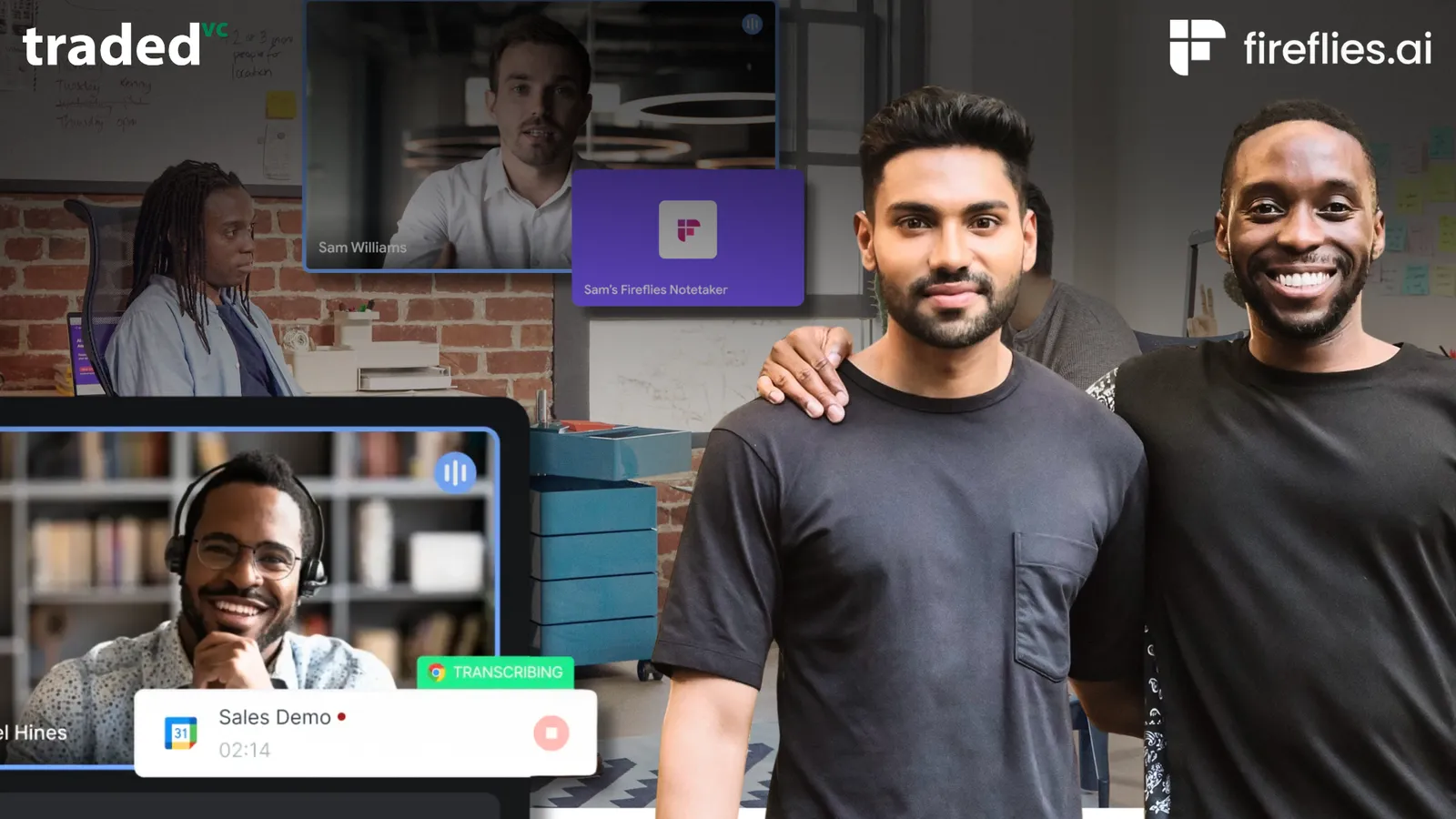
Fireflies.ai has quietly become one of the most consequential AI companies in the productivity space. With over 20 million users, more than 2 billion meeting minutes processed, and profitability achieved since 2023, the company defies the prevailing AI startup playbook of raising more, burning more. The company hit a billion-dollar valuation through a tender offer, not a primary raise, and has taken no new capital since its 2020 Series A.
We sat down with Krish Ramineni, co-founder and CEO, to unpack the full arc: six failed startups, living on $25,000 in San Francisco, the human-in-the-loop MVP that went viral, a pivotal connection to Sam Altman, and why Fireflies is now launching five new products in 2026 while maintaining healthy margins in one of AI’s most expensive verticals.
This is the story of compounding discipline.

The Origin: Six Ideas, One Breakthrough
Before Fireflies existed, Krish and his co-founder, Sam, tried six different startups. Crypto. Gig economy apps. A social consumer CRM. Each one chased a market trend rather than solving a problem they personally felt. The pattern kept repeating: build for six months, ship a great demo, watch real-world usage fall flat.
“Every time we built something, we thought we were solving a problem the market thought was interesting, versus a problem we ourselves felt deeply about. When it starts getting difficult, you have to ask: Can I wake up every day and want to work on this?”
The breakthrough came from constraint. Down to their last couple thousand dollars, Krish and Sam stopped chasing novelty and asked a simpler question: what do we actually need? The answer was a searchable database of past conversations. Even with imperfect transcription, if a tool could jog your memory across every meeting you’d ever had, that was a win.
That insight became Fireflies.
The critical difference this time: they talked to customers before writing code. The first 10 users were friends in their network. The initial product was deliberately low-tech. A human would join calls, take notes, and deliver them. If people would pay $100 a month for that service, the demand signal was real enough to justify building the AI.
“We validated it as part of our MVP beta test. Once we confirmed people wanted this and would pay for it, that’s when we said, okay, now let’s go write code and build the product.”

Capital Strategy: Bootstrap DNA in a Venture World
While peers in 2016 and 2017 were racing to raise institutional capital, Krish took the opposite approach. He and Sam lived on a $25,000 check from Rough Draft Ventures for an entire year in San Francisco. Sam drank Soylent and ate Domino’s pizza. Krish moved back home with his parents.
The logic was simple: it would be irresponsible to accept institutional money before achieving product-market fit or building a legitimate technology. Too many founders raise off a slide deck, then throw darts at the wall. Krish wanted to do that on his own dime first.
“If we didn’t have that DNA in those first couple years and those five, six failures, I don’t think we would have been responsible with how we used that money.”
The company applied to Y Combinator three times and was rejected all three. Twice, they made it to the interview stage. The common VC feedback was that the technology was hard to prove out at the time, pre-LLMs and ChatGPT. His philosophy was different: get the quick wins first, build the foundation, then swing bigger.
By the time they raised a $4.5 million seed led by Kanan Partners, they had 500 beta customers, and usage was growing week over week. Angel investors included the CMO of Salesforce, the former Chief Product Officer of Slack, and one of the earliest engineers at Dropbox.
“When you ask for advice, they want to give you money. When you ask for money, they’ll give you advice on why you’re not ready for money yet.”
Their $14 million Series A was led by an investor who started as an individual angel, later joined Khosla Ventures, and brought the deal with her. Krish raised it with a specific mindset: this is the last round we will ever take.
They have not raised a dollar since. Fireflies became profitable in 2023 and remains so today, with margins comparable to traditional SaaS businesses, in one of AI’s most capital-intensive verticals: voice.

The Growth Engine: Zero Marketing Dollars to 20 Million Users
When COVID hit in early 2020, Fireflies had just launched out of beta. The timing was extraordinary. Remote work exploded, and so did demand for AI meeting assistants. But the infrastructure was not ready.
“We were literally gluing the product together with duct tape. Every day our hair was on fire. I’d be up at 3 am, or Sam would get pinged at 2 am that the bot wasn’t working for users in India. We had to fix it before the heavy volume hit EST and PST.”
The engineering challenge was unprecedented. No one had built a meeting bot that could join calls at this scale and volume, around the clock. Fireflies had to forge their own architecture. The product had to show up to every meeting, on time, every single day, even when the founders couldn’t.
Krish made a deliberate bet: if the product was good enough, it would market itself. Until 2025, Fireflies spent zero dollars on marketing. Every one of its first 20 million users came through word of mouth and the natural viral loop of a meeting bot that other participants see working in real time.
The bet paid off. Organic growth compounded. Only in the past year has the company begun allocating modest marketing spend as a diversification experiment, not a dependency.
The OpenAI Connection: From Custom Models to a Trillion Tokens
In 2022, Fireflies was building its own models. Results were inconsistent. Then, a connection changed the company's trajectory. Vinod Khosla, one of Fireflies’ investors and the first venture investor in OpenAI, introduced Krish to Sam Altman.
Fireflies got early access to GPT-3.5, before it was publicly available. The existing searchable transcript engine suddenly had the ability to generate human-quality summaries, analytics, and meeting intelligence. The product went to another level.
Today, Fireflies is one of OpenAI’s largest consumers. The company received a plaque for processing a trillion tokens. The volume underscores the scale: billions of minutes of meetings, processed automatically, for users across every industry and time zone.
The Moat: Why 100+ Integrations and a Multi-Product Ecosystem Matter
The AI meeting assistant category is crowded. New entrants appear weekly. Krish sees this as validation, not a threat.
Fireflies’ differentiation sits across several layers. The platform has over 100 integrations, the most of any meeting assistant, including deep connections to Salesforce, HubSpot, and other enterprise systems. It was the first in its category to ship an MCP and the most robust API on the market. Developers are now building integrations on top of Fireflies, creating ecosystem lock-in.
Beyond note-taking, Fireflies built an AI skills directory. Post-meeting, the platform can generate to-do lists, extract feature requests, draft follow-up emails, create blog posts, and execute hundreds of other automated tasks. Meeting notes, as Krish frames it, are just one of hundreds of skills.
“Every week, there’s a new company coming up or another company pivoting into our space. But we spent five years building one world-class product. This year, we’re releasing up to five new products that expand the scope beyond just meeting notes.”
Those new products include voice agents that autonomously conduct interviews, a desktop app for note generation without a meeting bot, and an enhanced mobile app for in-person meetings. The multi-product evolution mirrors the playbook of Salesforce, HubSpot, and Atlassian: build a core platform, then expand into adjacent verticals.
The Data Advantage: 2 Billion Meeting Minutes and Counting
Processing over 2 billion meeting minutes creates compounding returns that a competitor starting today cannot replicate. Krish is clear that Fireflies does not train on customer data. The advantage is structural, not data mining.
Stress-testing a platform at that scale forced the team to build enterprise-grade infrastructure: access controls, admin controls, and data retention policies. Features that typically cost six or seven figures in the enterprise market are offered to users paying $10-20 a month.
Being a horizontal product, initially seen as a disadvantage by VCs, turned into a moat. Fireflies serves recruiting, sales, consulting,, media, and dozens of other verticals with tailored solutions for each. Seventy percent of customers are outside of Silicon Valley. The product has been used in UK Parliament proceedings, where output that previously took a week was delivered the same day.
“One of our vendors told me we process more data through them than Spotify.”
The Economics: Profitable AI at Venture Scale
Fireflies hit a $1 billion valuation through a tender offer, not a primary raise. The company has been profitable since 2023, has not raised capital since 2021, and maintains triple-digit year-over-year growth. In an era when the default AI playbook is "raise-everything, ignore-margins," this is an outlier story.
The team is 120 people. Comparable companies with similar revenue are at 500. Fireflies uses its own AI internally to automate processes, from scoring customer feedback to routing support. The company is, in Krish’s words, trying to be AI-native in every way.
“Could we be growing even faster if we chose to be unprofitable? Sure. But we’re growing at venture scale while staying profitable. We’re going to take everything we’re making and put it back into the product.”
Marketing is ROI-driven, with a rigorous data focus on customer acquisition and retention. It is, by Krish’s own admission, very anti-Silicon Valley. The discipline flows directly from those early years of living on $25,000 and eating Domino’s pizza.
The Vision: From Meeting Notes to AI Teammate
Krish has always viewed Fireflies as more than software. The original vision was to build a teammate, something so integrated into your workflow that you know it’s always there. Before the industry had a word for it, Fireflies was building agentic AI.
“We weren’t looking to build another piece of software that people open. We wanted to build a teammate. The first OG agent was Fireflies.”
The product reflects this philosophy. Users don’t have to read every summary or listen to every recording. They can ask Fred, the Fireflies AI, a question and get brought up to speed. Before a follow-up meeting, Fireflies sends a prep briefing that includes context from previous conversations and the opportunities discussed.
Every layer of friction removed is a layer closer to the moment a user realizes they can’t work without it. That has been the north star from the beginning, and it continues to drive the five new product launches planned for 2026.
Fireflies.ai is a case study in compounding discipline. Six failed ideas sharpened instincts. A $25,000 seed check built financial discipline that persists at scale. A human-in-the-loop MVP validated demand before a single line of code. A product-led growth engine generated 20 million users without marketing spend. And a refusal to chase the raise-and-burn cycle produced a profitable, billion-dollar AI company with no dependency on future capital.
Krish Ramineni built Fireflies by doing the opposite of what most AI founders are doing today. The results speak for themselves.
ABOUT THIS STORY
- Desk
- Articles
- Filed
- May 6, 2026
- By
- Traded Media