
Jul 2, 2026
fomo Raises $75 Million Series B to Build the World’s Largest Trading Platform
fomo, a social trading platform betting that "the future of social is going to be financially driven," has raised a $75 million Series B led by Index Ventures, joined by Union Square Ventures and existing backer Benchmar…
Traded Media

Traded Editorial
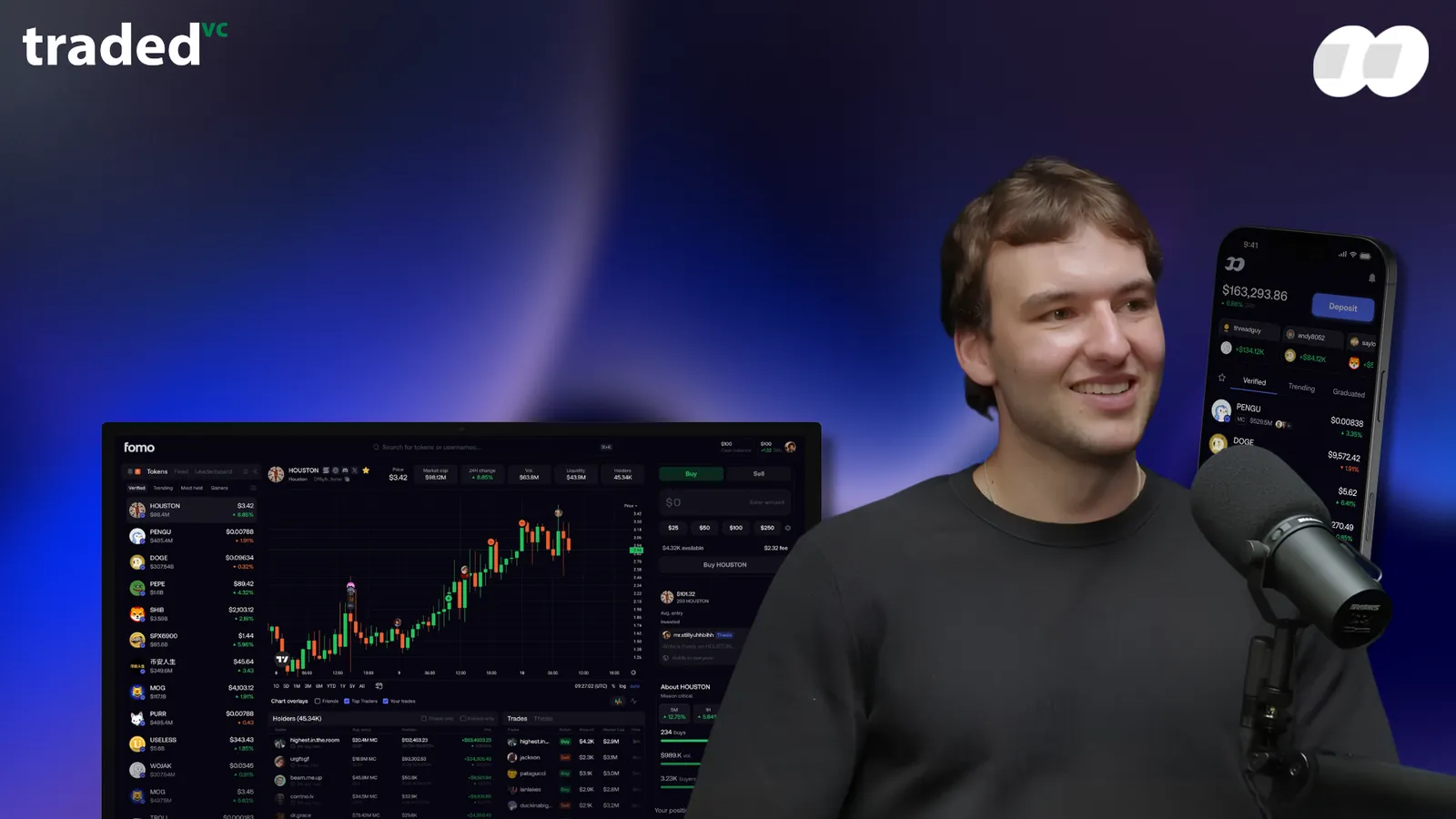
fomo has raised a $75 million Series B round as the company accelerates its mission to become the world's largest trading platform and redefine how people discover information, express conviction, and participate in financial markets. The round was led by Index Ventures, with participation from Union Square Ventures (USV) and existing investor Benchmark, which previously invested $15 million in the company.
According to fomo co-founder and CEO Paul Erlanger, investor involvement extends beyond capital. One of the company's closest partners throughout the fundraising process has been Julia Andre from Index Ventures, who will join fomo's board.
"The moment we met Julia, we noticed she had a ton of grit and ambition, which is aligned with our company values and culture. We knew that she would be a great partner for us." — Paul Erlanger
The financing also brings together respected technology investors, including Fred Wilson of Union Square Ventures and Jan Hammer of Index Ventures.
"Fred has been to our office several times to discuss product and vision. He's a legend." — Paul Erlanger
Wilson led Coinbase's Series A, while Hammer led Robinhood's Seed and Series A investments. According to Erlanger, both have been valuable partners as the company continues to scale. For Erlanger, however, the biggest story isn't the financing itself. It's the team behind it.
"The team is incredible. Every single person is essential for the business." — Paul Erlanger
From NYU and Yale to Building fomo
The origins of fomo trace back to a friendship formed during a college internship. Paul Erlanger was studying physics at NYU while his future co-founder, Se Yong Park, was studying economics at Yale. The two quickly became close friends, bonded by a shared competitiveness, ambition, empathy, and sense of integrity. After graduation, both entered traditional finance before realizing they wanted to build technology instead.
Erlanger joined dYdX as one of its earliest business development hires and later recruited Park to join the company. Together, they helped scale one of crypto's most successful decentralized trading platforms. fomo's founding team was completed by Prashan Dharmesena, the company's third co-founder and engineering leader. Dharmesena previously worked as a mobile engineer at dYdX and OpenSea, bringing deep technical expertise to the founding team.
Many members of today's fomo team also came from dYdX, while others previously worked at companies including Uniswap and OpenSea. The combination of Erlanger's product and growth background, Park's deep understanding of trading, and Dharmesena's engineering leadership helped shape fomo's early vision and execution.
The experience at dYdX taught Erlanger what a great company culture could feel like.
"The culture was amazing. You would look forward to the weeks more than you would the weekends." — Paul Erlanger
When that feeling began to disappear, he trusted his instincts.
"I'm a very instinctual person, and I trust my intuition." — Paul Erlanger
Originally planning to take more than a year off, Erlanger instead found himself building again within months. Soon after, the idea for fomo emerged.
Building a Different Kind of Consumer Platform
From day one, fomo's founders believed they were building more than another crypto product.
"We're not a crypto app. We're building the biggest trading app in the world." — Paul Erlanger
The company initially launched with a unique fundraising strategy. Rather than accepting institutional capital, fomo raised its seed round from approximately 140 angel investors.
"Our goal was to never take institutional capital." — Paul Erlanger
The strategy was designed to solve one of the hardest problems in consumer startups: distribution. Because fomo is built around social trading, the founders wanted many of their earliest users to become owners. By bringing in many active traders as angel investors, the company simultaneously bootstrapped liquidity, community engagement, and user growth.
"It helped solve the cold start problem and bootstrap our consumer growth." — Paul Erlanger
Only later did the founders decide to bring on institutional investors. Benchmark became fomo's first major venture partner and represented a rare crypto investment for the firm, which has historically focused on category-defining consumer technology companies.
"They know how to scale the biggest consumer businesses in the world." — Paul Erlanger
Rapid Growth Since Launch
The strategy appears to be working. In roughly a year since launch, fomo has grown to nearly 650,000 lifetime users and now processes between $20 million and $40 million in daily trading volume. The company has achieved that growth while remaining remarkably capital efficient.
"We spend maybe a little over $100,000 a month on growth." — Paul Erlanger
In fact, the company was not actively fundraising when investors approached.
"The most difficult part of raising this round was figuring out if we needed to do it." — Paul Erlanger
Erlanger noted that the company currently has more money in the bank than it has ever raised and emphasized that the financing was largely opportunistic rather than necessary.
"We're making money. Our goal is to never fundraise again." — Paul Erlanger
While he admits that could change in the future, the statement reflects the company's focus on building a sustainable business rather than chasing capital. For the founders, the decision ultimately came down to whether the investor group could help accelerate fomo's long-term vision. With support from Benchmark, Index Ventures, and Union Square Ventures, the team believed the partnership would help them continue scaling what they hope becomes the world's largest trading platform.
A Team Built for Speed
One of the recurring themes throughout Erlanger's story is execution. Before founding fomo, several members of the team helped scale dYdX during its rise to dominance in decentralized perpetual futures trading.
"We were like Hyperliquid before Hyperliquid." — Paul Erlanger
That experience has translated into an unusually high level of product velocity. Most recently, the company launched its perpetual futures trading product in just three weeks from start to finish.
"We built our perps product in three weeks." — Paul Erlanger
Erlanger credits that speed entirely to the team.
"Couldn't do it without them." — Paul Erlanger
The achievement reinforced something he repeatedly emphasized: while the fundraising headlines may focus on founders and investors, fomo's success is ultimately driven by a team of operators, engineers, designers, and builders who have spent years working on some of crypto's most important products.
The Competitive Advantage Competitors Can't Copy
While many companies can build trading functionality, Erlanger believes fomo's true moat is its social graph. Unlike many platforms in the trading and crypto industries, fomo has never paid users to trade.
"fomo has never paid a single trader a single dollar to trade on the platform." — Paul Erlanger
Instead, users build audiences, reputations, and identities through their activity. Some traders have already accumulated more than 100,000 followers.
"Once you start to build an identity on fomo, you can't replicate that anywhere else." — Paul Erlanger
That social graph creates a network effect that becomes stronger as more users participate. Instead of simply executing trades, users follow people, discover ideas, evaluate performance, and build credibility. Erlanger believes this dynamic is significantly harder to replicate than trading infrastructure itself.
The Feature That Surprised Everyone
One of the most unexpected discoveries since launch came from fomo's leaderboard system.
"We underestimated how much people love status games." — Paul Erlanger
The leaderboard ranks users based on performance, allowing traders to build public reputations around actual results. According to Erlanger, users regularly contact the company when they disappear from rankings or lose visibility within the platform's social features. The behavior revealed something important: in traditional finance, performance is often hidden, exaggerated, or difficult to verify. fomo's transparent system created an environment where reputation could be earned through demonstrated results.
"People really care about being at the top of the leaderboard." — Paul Erlanger
For the team, it became one of the clearest signals that the social layer was working.
A Product Decision That Could Have Changed Everything
One early product decision illustrates how carefully fomo thinks about network effects. Before launch, the company considered introducing a private mode that would allow users to hide their activity. Ultimately, the team decided against it. If private accounts existed, Erlanger believed the optimal strategy would be for everyone to hide their trades, which would eliminate the transparency that powers the platform's social graph. Instead, users can remain pseudonymous while maintaining visibility into their activity, creating a balance between privacy and transparency that has become central to the product.
Why the Future of Social Is Financial
Perhaps the most important idea behind fomo is Erlanger's belief that social media is evolving.
"I think the future of social is going to be financially driven." — Paul Erlanger
His argument is rooted in artificial intelligence. As AI makes content creation increasingly abundant, Erlanger believes authentic signals become more valuable.
"Anyone can generate content. Your conviction is where you put your money." — Paul Erlanger
Rather than measuring influence through likes, posts, or generated content, fomo allows users to demonstrate what they actually believe through financial decisions. The result is a platform where conviction becomes visible. Whether users are trading crypto, equities, commodities, prediction markets, or future asset classes, the core concept remains the same: actions speak louder than content.
Erlanger often compares fomo's opportunity to the role Robinhood played in expanding retail investing. He believes many Robinhood users would never have opened traditional brokerage accounts, and that fomo can similarly bring entirely new participants into financial markets.
"Everyone deserves access to these markets." — Paul Erlanger
For many people outside the United States, access to U.S. equities and other financial products remains difficult. Erlanger believes blockchain infrastructure can help remove those barriers and create a more accessible global financial system. Rather than simply competing for existing traders, fomo aims to introduce investing to millions of people who may never have participated otherwise.
Building the Infrastructure for Global Markets
fomo's ambitions extend well beyond crypto. The company currently relies on various external providers for data indexing, execution, routing, token data, and onboarding infrastructure. The new capital will allow the team to build more of that stack internally while expanding into additional asset classes.
"We want equities. We want commodities." — Paul Erlanger
Erlanger compares today's blockchain ecosystem to the transition from paper-based stock trading to computerized trading in the 1970s. Just as digital trading eventually became the standard, he believes financial assets are increasingly moving on-chain. As that shift occurs, fomo aims to become the consumer platform that makes those markets accessible globally.
"There is no consumer finance platform that gives easy access to these on-chain assets." — Paul Erlanger
Despite the company's growth, Erlanger says one challenge remains particularly important: onboarding.
"The largest piece of friction right now is the on-ramp." — Paul Erlanger
While experienced crypto users are familiar with moving assets on-chain, making that process simple for mainstream users remains one of the industry's biggest challenges. fomo is actively investing in onboarding experiences that make depositing funds and accessing markets as intuitive as possible for everyday consumers.
Company Culture and Hiring Philosophy
As fomo grows, Erlanger remains focused on maintaining the culture that attracted many employees in the first place. The company hires for three primary qualities: founder mentality, genuine passion for the mission, and high integrity.
"If you make a technical mistake, that can be fixed. Compromising your integrity can't." — Paul Erlanger
Internally, the company follows a simple philosophy:
"How we do anything is how we do everything." — Paul Erlanger
From product design and engineering to events, branding, and merchandise, the team obsesses over details.
"We'll spend hours debating button colors." — Paul Erlanger
The company also embraces what Erlanger calls "meta intentionality," the idea that not everything needs to be perfect, but important moments deserve extraordinary attention. Whether it's a major product launch, a company announcement, or a customer-facing experience, the team believes intentional execution compounds over time.
Erlanger also shared one lesson he has learned throughout the startup journey:
"Have the hard conversations as soon as you can." — Paul Erlanger
Whether renegotiating contracts, making difficult personnel decisions, or addressing problems internally, he believes founders must confront challenges directly rather than allowing them to grow over time.
Looking Ahead
Despite serving hundreds of thousands of users, processing tens of millions of dollars in daily volume, and raising capital from some of Silicon Valley's most respected investors, Erlanger insists the company is still in the earliest stages of its journey. His long-term vision is ambitious: in ten years, he hopes fomo serves hundreds of millions, and potentially billions, of users around the world. The platform would become a place where people discover opportunities, express conviction, access financial markets, and build reputations around their ideas.
At a time when many consumers remain skeptical of crypto, Erlanger also believes trust will become a defining differentiator.
"We want to be a beacon of light." — Paul Erlanger
That mission extends beyond growth. Erlanger argues that trust remains one of the largest challenges facing the broader crypto industry.
"We have the best consumer protection of any on-chain trading application that has ever existed." — Paul Erlanger
The company has invested heavily in fraud prevention, trader protections, and user safety mechanisms, hoping to create an environment where consumers can participate confidently in on-chain markets. As fomo scales, Erlanger believes trust, transparency, and consumer protection will become just as important as product innovation. For Erlanger, the mission remains simple:
"We want to give access to everyone who wants to invest. We want to be the largest trading app in the world." — Paul Erlanger