

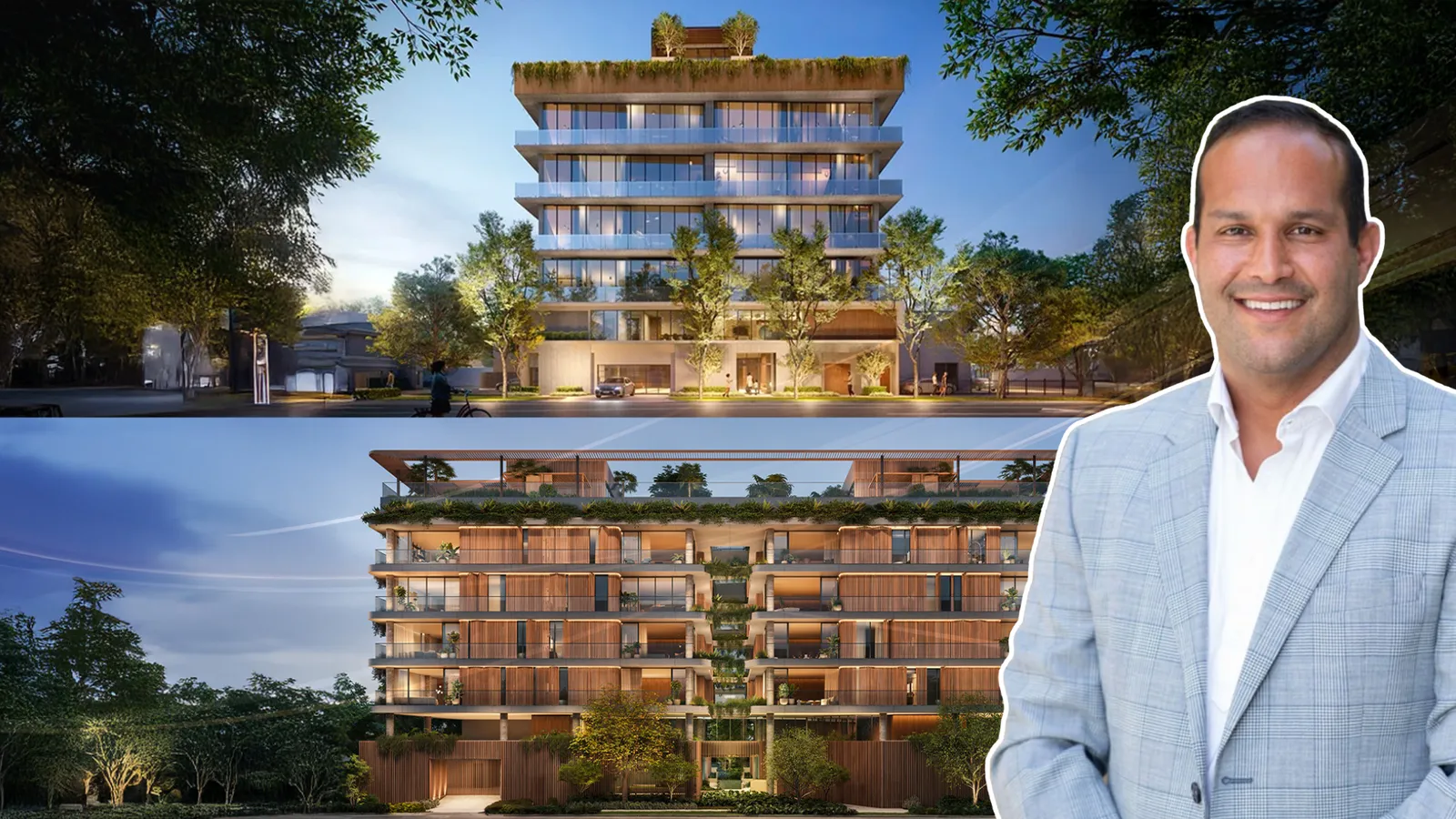

Miami’s skyline continues to climb, defined by glass towers, branded residences, and ever-expanding amenity decks. Yet amid the surge of high-rise luxury, Andrew Rasken is deliberately moving in a different direction. As CEO of META Development, Rasken has built a reputation around restraint, focusing on low-density, design-forward residential buildings that prioritize privacy, proportion, and livability over spectacle. Rather than competing on height or volume, META Development has embraced what Rasken calls a “Think Wrong” mentality, a philosophy rooted in challenging industry defaults and resisting formula-driven development.
“At META Development, our philosophy begins with a simple belief: doing what everyone else is doing rarely creates anything lasting,” Rasken explains. “‘Think Wrong’ is our internal shorthand for questioning default assumptions about scale, luxury, density, even success itself.” Instead of pursuing volume-driven projects, the firm approaches each building as a bespoke commission, beginning with a close study of neighborhood context, light, culture, and how residents actually live. From there comes what he describes as relentless editing. “Fewer residences. Clearer ideas. Stronger identity.” For Rasken, thinking differently is not about being contrarian for its own sake. It is about conviction. “It’s about having the discipline to build what feels right, even when it doesn’t follow the prevailing formula.”
Challenging Miami’s High-Rise Formula
Over the last decade, Miami has experienced an unprecedented wave of luxury tower development, yet META Development intentionally stepped away from that model. “Density is easy. Intimacy is hard,” Rasken says, arguing that the city does not suffer from a lack of luxury but from repetition. He identified a growing segment of buyers seeking privacy and emotional connection rather than spectacle. “Low-density projects allow us to design with human scale in mind. They create quieter buildings, stronger communities, and residences that age gracefully. In our view, true luxury today is not about height. It is about how a place feels when you come home.” This perspective has positioned META Development within a niche that continues to gain traction as buyers look beyond height and branding toward experience and livability.
Designing for Intimacy Over Density
That philosophy is clearly expressed at OPUS Coconut Grove, a fourteen-residence project and META Development’s first collaboration with SERHANT as broker of record. “OPUS is a project rooted in authorship, not branding,” Rasken says. “That aligns perfectly with SERHANT’s ability to tell original stories rather than sell a generic product.” He describes Coconut Grove buyers as highly sophisticated, often end users who could purchase single-family homes but prefer a curated condominium experience without sacrificing privacy. “It’s not a mass-market message. OPUS doesn’t need volume. It needs clarity.” With just fourteen residences, META Development was able to focus on precision at every level. “Every floor plan matters. Every circulation decision matters. We can offer private elevators, generous terraces, and layouts that feel closer to single-family living than condominium life.” Larger developments, he notes, optimize for efficiency. META Development optimizes for livability, emphasizing fewer neighbors, quieter common spaces, and a building that feels personal rather than anonymous.
Context, Character, and the Boutique DNA
The same philosophy carries into Colette Residences in South Brickell, though the tone shifts to reflect its context. “OPUS is introspective and grounded, very much of the Grove. Colette is urban, refined, and editorial, perfectly suited to South Brickell,” Rasken explains. While stylistically distinct, both projects share the same META Development DNA: restraint, proportion, and intention. “We don’t believe in repeating ourselves stylistically. Each project responds to its context. But the philosophy, Go Boutique, design as experience, fewer things done beautifully, remains constant.” For Rasken, architecture and positioning must feel inevitable within their surroundings rather than imposed upon them, a principle that reinforces the firm’s commitment to boutique scale and clarity of concept.
Redefining Luxury Value
Rasken believes today’s luxury buyer has fundamentally redefined value. “Value today is less about square footage and more about quality of life per square foot.” Buyers are increasingly focused on how a residence feels and functions, asking practical questions about privacy, elevator access, calmness, and ease of living. In neighborhoods like Coconut Grove and South Brickell, value is tied to walkability, privacy, and emotional comfort. “Luxury has shifted from accumulation to curation.” That shift informs META Development’s concept of delivering single-family living in the sky. The approach begins with privacy through private elevators, limited residences per floor, and layouts that eliminate unnecessary corridors. It extends to generous kitchens, defined dining areas, terraces designed as outdoor rooms, and ceiling heights that allow natural light to shape the experience. “When a residence feels personal, when it doesn’t feel like a hotel, you live differently in it. That’s the goal.”
Growing with Discipline
With OPUS and Colette now launched and a third project scheduled for 2026, META Development is approaching growth carefully. “Growth for us is not about speed or volume. It is about continuity of standards,” Rasken says. The firm remains highly selective about sites and partnerships, insisting that each project justify its existence creatively and culturally. “If we can’t make it better by being boutique, we won’t do it.” Looking ahead, he sees the greatest opportunity in what he calls human-scaled luxury. As buyers grow fatigued by mega-projects, rising HOA fees, and hotel-style living, demand is shifting toward smaller, design-forward buildings in established neighborhoods that prioritize long-term livability over short-term spectacle.
When asked what advice he would offer new developers, Rasken is direct. “Learn construction. Learn finance. But most importantly, learn judgment.” He emphasizes that reputation is shaped as much by restraint as ambition. “Not every deal should be done. Not every trend should be followed. Your reputation will be shaped more by what you choose not to build than what you do.” Ultimately, he does not view META Development simply as a builder of structures. “We don’t see ourselves as builders of buildings. We see ourselves as editors of urban life,” he says. “Our responsibility is to contribute something thoughtful to the city, something that belongs. If a META Development project feels inevitable in its place, quietly confident, well-proportioned, and deeply livable, then we’ve done our job.” In a market defined by vertical ambition, Andrew Rasken is proving that sometimes the boldest move is to build less and mean more.