

Nov 4, 2026
EBALDC Replaces Planned 28-Story Oakland Tower With 112-Unit Affordable One Fallon Project
The East Bay Asian Local Development Corporation has submitted revised plans for One Fallon, an eight-story affordable housing project with 112 apartments near the Lake Merritt BART Station.

Photo via Solomon Cordwell Buenz

Traded Editorial
- East Bay Asian Local Development Corporation (EBALDC) has submitted revised plans for One Fallon, an eight-story affordable housing project at the Lake Merritt BART redevelopment in Oakland.
- The project will deliver 112 apartments, with 111 deed-restricted for very low- and low-income households.
- The revised proposal replaces a previously planned 28-story, 360-unit market-rate tower led by Strada Investment Group.
Affordable Housing Takes Center Stage at Lake Merritt BART
Plans have changed for a major transit-oriented development in Downtown Oakland. EBALDC has filed an updated application for One Fallon, shifting the second half of Block One from a mostly market-rate high-rise to an eight-story affordable housing building. Located along 9th Street between Oak and Fallon streets, the project sits beside Lake Merritt BART Station and Laney College. The change places affordable housing at the center of a redevelopment intended to bring new homes, commercial space, and public improvements to BART-owned property. The revised application, designed by Solomon Cordwell Buenz, focuses on the new residential program, its transit-connected location, and the broader master plan’s evolving mix of uses.
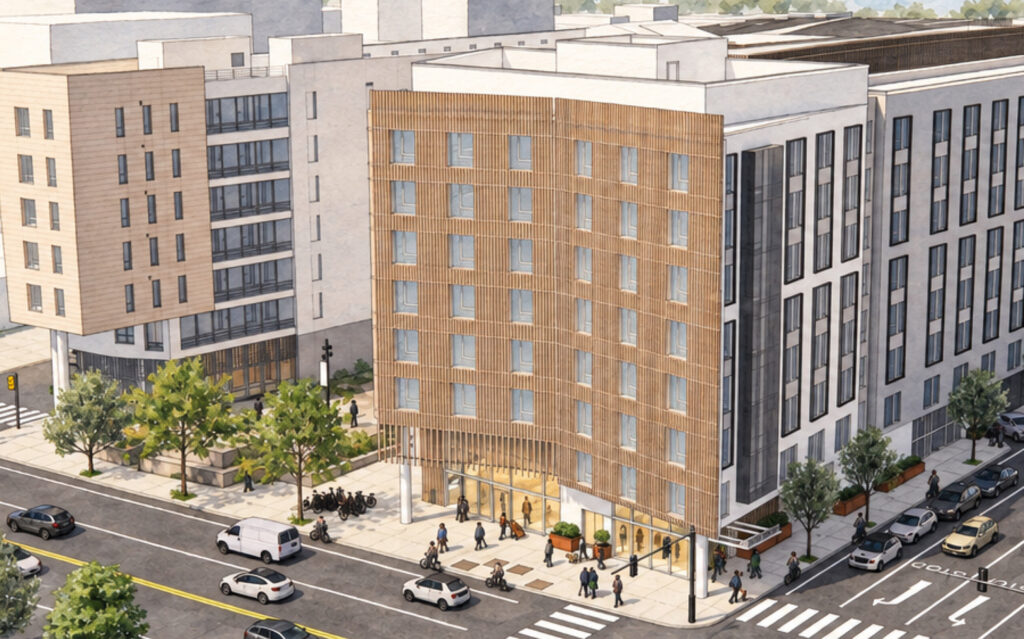
One Fallon: 112 Apartments, 111 Affordable
The proposed 85-foot-tall building will contain approximately 132,200 square feet, including 114,150 square feet of housing and 7,620 square feet of ground-floor retail. The unit mix includes 12 studios, 43 one-bedroom apartments, 27 two-bedroom apartments, and 30 three-bedroom apartments. Of the 112 homes, 62 will be restricted for very low-income households and 49 for low-income households. The remaining unit will be a market-rate apartment for the on-site property manager. The project will also include parking for 17 vehicles and 60 bicycles. Planned ground-floor uses include a garage, community room, residential services offices, and flexible space facing a proposed public paseo. A podium-top terrace and amenity flex room are planned for the second floor.
EBALDC, Strada and BART’s Larger Redevelopment
The Lake Merritt BART redevelopment is a partnership involving EBALDC, Strada Investment Group, and Bay Area Rapid Transit (BART). The larger master plan covers two blocks and envisions housing, office space, retail, and public access improvements. BART’s official project overview includes affordable senior housing, family affordable units, and a market-rate residential building as part of the broader development program. Construction is nearing completion on Building B, the seven-story affordable senior housing project designed by PYATOK. That phase is part of the first development block and is being delivered alongside a publicly accessible paseo. The earlier plan for the remaining Block One parcel called for Strada to develop a 28-story tower with 360 apartments, including 36 affordable units, plus ground-floor retail. One Fallon’s updated proposal significantly changes the density, height, and affordability profile of that portion of the site.
Streamlined Approvals, No Construction Timeline Yet
The One Fallon application invokes Assembly Bill 2011, Senate Bill 330, and California’s State Density Bonus Law to streamline approval. While the proposal remains below the maximum base density of 176 units, the applicant is seeking waivers and incentives related to ground-floor height and bulk controls. The project’s estimated construction cost and timeline have not yet been announced.
Investor Takeaway
One Fallon reflects a shift in the Lake Merritt BART redevelopment toward a deeper affordable housing component, while the larger site remains a major transit-oriented development opportunity. For Oakland’s housing and commercial real estate landscape, the revised plans show how entitlement strategy, public land partnerships, and affordability requirements can reshape a project’s original market-rate vision.