

Jul 14, 2025
Arbor’s New Report Finds SFR Sector Strong and Stable

Traded Editorial
Key Points
-
Rent growth is up 4.1% year-over-year, steady above inflation and just shy of pre-pandemic norms.
-
CMBS issuance surged to $7.8 billion in 2024 (+179%), and $1.8 billion in Q1 2025, signaling a strong year ahead.
-
Occupancy and tenant retention have stabilized, with mid-80% lease renewals and overall occupancy near 93.7%.
A new report from Arbor shows the single-family rental (SFR) market balancing growth and maturity in Q2 2025. With affordability pressures locking out many potential homebuyers, operators are focusing on keeping tenants in place while build-to-rent (BTR) supply and capital markets activity stay strong.
Market Context: Stability After a Surge
-
Housing affordability remains tight. The median U.S. household would need to spend about 46% of income to buy a home, so two-thirds of renters now see leasing as a long-term solution.
-
Homebuilding inventory has risen and prices are moderating. SFR rent growth has eased below pre-COVID averages but still outpaces inflation.
-
Construction is leveling off after rapid expansion, suggesting the market is settling into a more sustainable cycle.
Rent Trends & Metro Performance
-
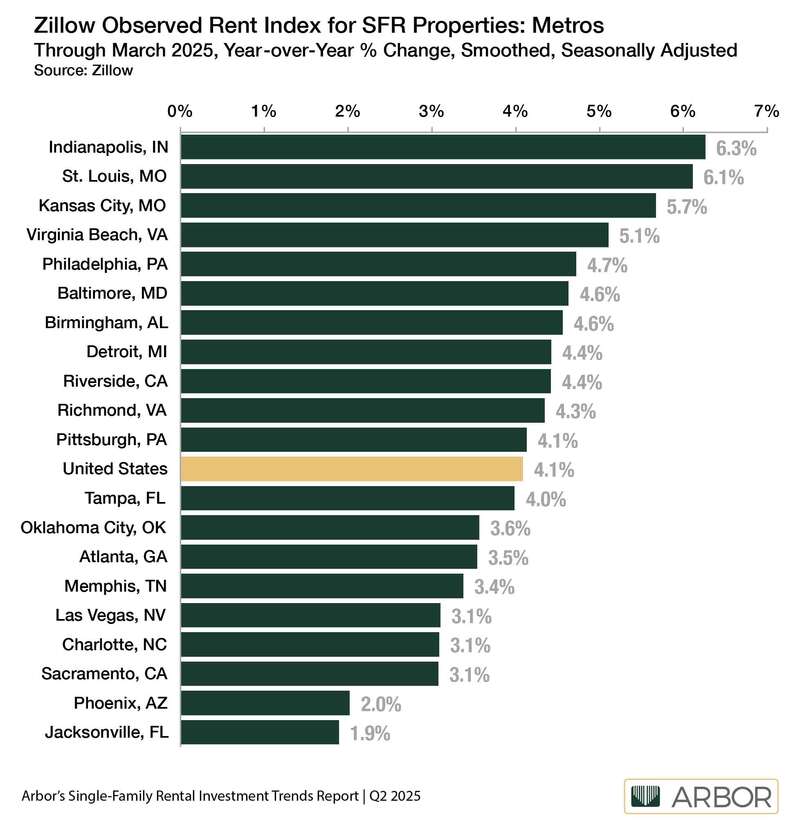
National rents rose 4.1% year-over-year through March 2025, according to Zillow—slightly under the 2016–2019 average of 4.4%. Growth has slowed since December but remains solid.
-
Leading markets include Indianapolis (+6.3%), St. Louis (+6.1%), and Kansas City (+5.7%). Slower metros include Jacksonville (+1.9%), Phoenix (+2.0%), and Sacramento (+3.0%).
Occupancy & Retention
-
Occupancy averaged 93.7% in Q1 2025, down slightly but still outperforming other rental segments.
-
Lease renewal rates fell from 87.3% in mid-2022 to 79.2% in April 2024 but rebounded to 84.3% by year-end, showing operators’ renewed focus on tenant retention.
Capital Markets & Cap Rates
-
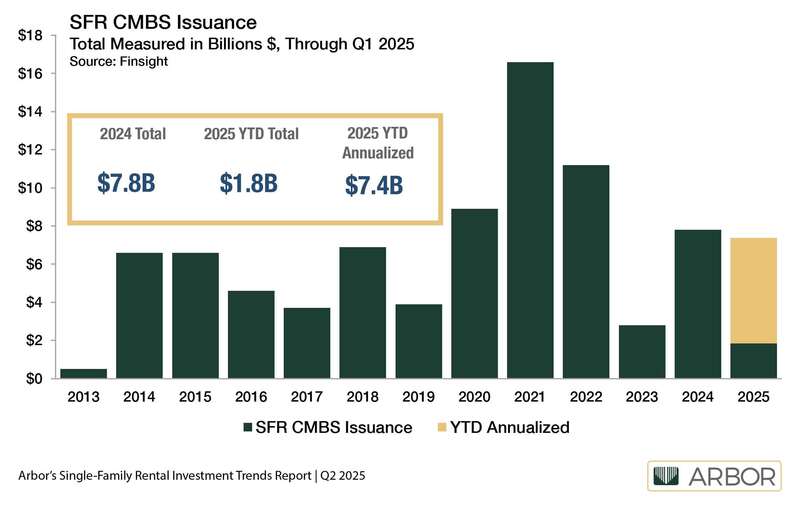
SFR CMBS issuance totaled $7.8 billion in 2024 (+179% year-over-year) and hit $1.8 billion in Q1 2025, on pace for another strong annual total.
-
Cap rates rose to 6.8% in Q1 2025, up slightly from 6.7% as broader rate pressures persist. Since 2021, cap rates have climbed about 149 basis points from historic lows.
-
Risk spreads tightened slightly. The SFR spread over Treasuries sits around 236 basis points, with a 122 basis point premium over multifamily.
Price & Credit Trends
-
Zillow reports the average SFR home value at $362,922 (+2.3% year-over-year). After 24 months of gains, March posted a slight 0.1% decline. Zillow forecasts a 1.7% dip through March 2026.
-
Debt yields are up to 10.8% in Q1 2025 (+230 basis points since 2021). Average debt coverage has slipped to $9.29 per $1 of NOI—about 20% lower than prior peaks.
-
Mortgage delinquencies remain low at 0.9% for payments 90+ days late, slightly better than before the pandemic. SFR CMBS delinquencies were at 2.1% in January 2025, down year-over-year.
BTR & Supply Outlook
-
BTR construction remains healthy with 84,000 units started in the past year—roughly 8.4% of all single-family starts. Activity has pulled back slightly from mid-2024 peaks but remains within a stable range.
-
Overall, the sector appears to be settling into a balanced, sustainable phase—neither overheating nor cooling too sharply.
Conclusion
The SFR market remains strong yet stable. Rent growth and investor demand are holding up, CMBS funding is flowing, and new construction is pacing steadily. With affordability still a barrier to homeownership, operators are wisely focusing on tenant retention and community value. As mortgage rates stay high, SFR continues to be a compelling play for commercial real estate investors. Strong tenant care and asset management will be key differentiators as this asset class matures.
Sources: Arbor Realty Trust, Chandan Economics, Zillow