

Brendan Wallace Built Fifth Wall by Finding Real Estate Where No One Else Was Looking
From Opendoor to Lime to a $135 million bet on Travis Kalanick's ATOMS, the Fifth Wall Founder, CEO, and CIO explains why the biggest opportunities in real estate keep arriving disguised as technology companies…and wh…
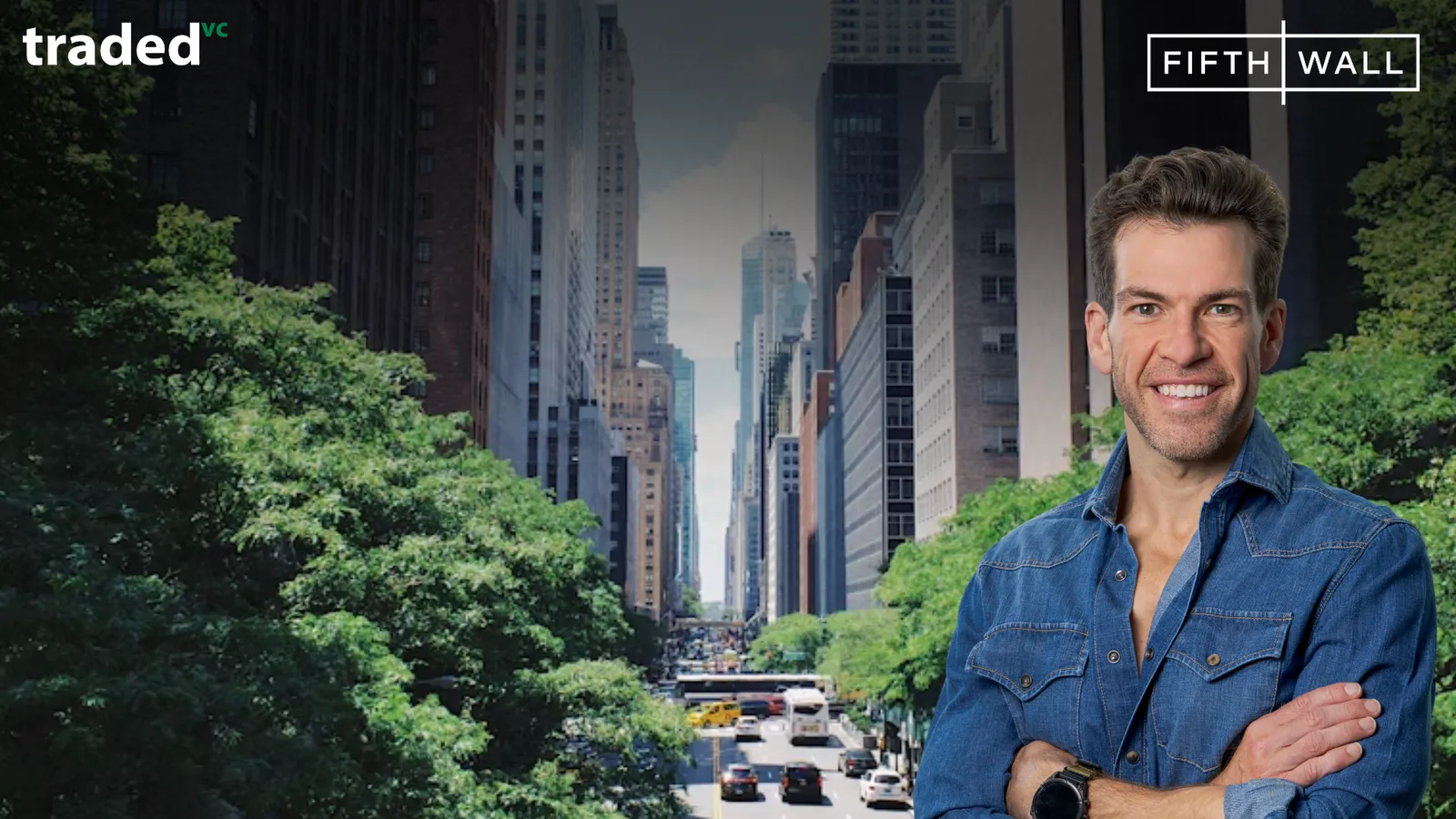
Brendan Wallace doesn’t describe himself as a real estate investor, or even a proptech investor. He describes himself as someone who tries to stand where capital markets are going to be before the market agrees the destination exists.
“I think that’s kind of what I’ve always tried to do in my career — identify where I think capital markets are going before they get there,” Wallace told TradedVC. “Fifth Wall, even the existence of Fifth Wall, is probably an example of that.”
The pattern predates the firm. He co-founded a data company before “big data” was a phrase anyone used, backed Cabify before ride-hailing was mainstream, and launched Fifth Wall in 2016 around what he calls the secular collision between real estate and technology — at a time when essentially no one was underwriting that collision. He ran the play again in 2019, standing up Fifth Wall’s Climate Fund before climate was a mainstream institutional theme. It went on to raise close to $1 billion. Today 115 real estate companies are limited partners in Fifth Wall funds — among them CBRE, Hines, Related Companies, Public Storage, Blackstone Real Estate, Starwood Capital, Prologis, Marriott International, Hilton, Digital Realty, Lineage, Toll Brothers, D.R. Horton, PulteGroup, British Land, SEGRO, Kimco Realty, Cushman & Wakefield, Invitation Homes and News Corp — largely to get early access to the asset classes he keeps describing.
From a Princeton Thesis to the Front Lines of Blackstone
The obsession started early. Wallace wrote his Princeton senior thesis on urban development and the political economy of why cities build stadiums to drive downtown growth — why, in other words, humans arrange space the way they do.
He carried that question into real estate investment banking at Goldman Sachs, then to Blackstone, arriving exactly as Jon Gray’s real estate group was becoming the engine of the entire firm. Fresh out of college, he was thrown onto the 2007 buyout of Sam Zell’s Equity Office Properties, then onto the Hilton Hotels acquisition — a deal that had him spending months in Hawaii trying to sell off the company’s island assets right as commercial real estate fell off a cliff.
“I kind of spent the first five years of my career really at the front lines of real estate capital markets, riding the wave all the way up and seeing how profoundly that wave could shift,” he said.
That whiplash — peak to collapse in a single deal cycle — is the foundation of how he underwrites risk today. Blackstone is also where Fifth Wall began as an idea: Wallace initially pitched the concept to Blackstone itself before leaving to build the firm on his own.
The Two Things Everyone Missed About Proptech
When Fifth Wall launched, the consensus was that technology and real estate simply didn’t belong in the same fund. Wallace says the skeptics missed two separate things.
The first was straightforward: real estate is unusually slow to adopt technology, and when it finally does, the value created is enormous. Fifth Wall’s IPO roster — ServiceTitan, Blend, Procore — was built on exactly that lag, with pure-play software companies capturing decades of deferred digitization.
The second is the part he considers the firm’s real edge, and the part he thinks the market still doesn’t understand.
“What people don’t understand about proptech is that it’s not just tech — it’s actually real estate companies themselves that are being built,” he said. “The next data center asset class is probably hiding inside Fifth Wall’s venture capital portfolio right now.”
His evidence is historical. Real estate dismissed data centers as digital infrastructure for years; today every major manager has a data center fund. Cell towers weren’t taken seriously as real estate until they became some of the largest REITs on earth. Industrial was a backwater of warehouses until e-commerce turned Prologis into a giant. Cold storage, single-family rental, logistics — same story, over and over.
Opendoor: The $82 Million Bet That Made the Firm
Fifth Wall’s first fund was $212 million. Wallace put $82 million of it — nearly 40% — into a single company.
That company was Opendoor, and the thesis wasn’t software. It was that Opendoor was enfranchising an entirely new type of real estate company: the iBuyer. Wallace says the position returned 4.4x on Fifth Wall’s investment, or 1.7x the firm’s entire first fund, in under five years and put the firm on the map, with Fifth Wall as the largest investor and, in his words, instrumental in bringing the asset class to the fore.
He ran the same play in flex office. While the market fixated on WeWork, Fifth Wall went the other direction and made a significant investment in Industrious — which he believes became the only enduring success story of that co-working cohort. Fifth Wall advised on and orchestrated CBRE’s investment and eventual acquisition of the company.
Lime and the “Dock Company” Thesis
Ask Wallace which investment looked craziest at the time and now looks obvious, and the answer is immediate: Lime.
Investors couldn’t see the real estate in a scooter company. Wallace could, because he’d been studying Citi Bike.
“It’s not a bike company, it’s a dock company,” he said. “Those docks are so valuable — I think some of the most valuable real estate in New York.”
The scooters, he argues, are the least important asset in the business. The asset is the concession — the right to operate on specific curbs, docks, and charging infrastructure in specific cities. Lime now operates in roughly 230 cities, has done more than a billion rides, is cash-flow positive, and went public earlier this month at a $1.8 billion valuation.
“Micromobility is an entirely new asset class of real estate,” he said.
Add up the rest of the portfolio built on that logic — GoPuff, ShipBob and Cargomatic in last-mile logistics, Loft in iBuying, Metropolis in tech-enabled parking, Neighbor in distributed storage, Homebound in next-generation homebuilding, EV Realty in commercial EV charging, Koloma in geologic hydrogen — and Wallace estimates roughly $30 billion of value sitting in companies most of the industry still doesn’t classify as real estate at all.
The ATOMS Bet: Fifth Wall’s Largest Check Ever
That thesis just met its biggest test. Fifth Wall’s newest fund led a $135 million investment, alongside Andreessen Horowitz, into ATOMS, Travis Kalanick’s new company — the largest single investment in the firm’s history.
Wallace doesn’t frame it as mobility, autonomy, or robotics.
“They own and operate real estate. Real estate is fundamental to everything they’re doing,” he said. “I think ATOMS will enfranchise an entirely new asset class of real estate. That’s one of the reasons why we leaned in so heavily.”
He credits the conviction to two inseparable things: Kalanick and the team around him.
“Travis was the person I looked up to the most on my entrepreneurial journey,” Wallace said. “I can’t think of any entrepreneur that has changed the physical environment in our generation more than Travis.”
The full-circle detail he can’t get over: ATOMS’ CFO, Gautam Gupta, was CFO of Opendoor when Fifth Wall wrote the check that made the firm. There’s also scale — ATOMS’ physical footprint is large, though Wallace said he isn’t able to disclose how large.
Seen together, the arc is remarkably consistent: $82 million from a $212 million fund in 2016, $135 million today, both underwritten by the same idea.
Why the Industry Keeps Getting Blindsided
So why does an industry this well capitalized keep missing categories until they’re obvious? Wallace’s answer is unusual for a real estate investor: the industry stopped thinking like sociologists.
“The real estate industry has lost its ability to view itself sociologically, or view space sociologically,” he said. “The definition of real estate is how humans use space to create the economy.”
When an investor is myopically focused on one asset class — malls, offices, retail — they stop asking the base question of why humans use space that way at all. That blindness is what makes disruption feel like it arrives sideways. If you only study brick-and-mortar retail, you never see e-commerce coming, because e-commerce is a behavioral change, not a real estate one. If you assume people go to offices because people go to offices, you never ask whether the work could happen at home. COVID asked the question for the industry.
The Next Wave of Hidden Asset Classes
Wallace says the same setup is happening right now, in categories still filed under “tech”:
- Ghost and commissary kitchens — about to become massive, in his view
- Edge data centers — compute at the edge of consumer networks rather than hyperscale campuses
- Stationary batteries — the American grid needs enormous storage, and storage has to live somewhere
- Vertiports and drone ports — rooftops become revenue-generating real estate for drone delivery
- Vertical farming — including controlled-environment and cannabis cultivation
“All of those are thought of as tech companies today. They’re not thought of as real estate companies,” he said. “And that’s exactly the point.”
Asked what he’d build if he started Fifth Wall from scratch today, he mostly wouldn’t change the strategy — with one addition. He believes retail capital markets will matter enormously to both tech and real estate, and it’s the area he’d like more exposure to.
Ten IPOs in Ten Years, and the One Lesson Behind Them
Ten Fifth Wall portfolio companies have reached the public markets in the firm’s first decade. Those ten companies — among them Opendoor, Procore, ServiceTitan and Lime — are collectively worth more than $30 billion, and the private portfolio behind them includes Bilt, ATOMS, GoPuff, Metropolis, HighArc and Juniper Square. Wallace distills the lesson into one sentence.
“Value asymmetrically concentrates into the market leader even more than you expect,” he said. “The difference between being first and second is way more dramatic than anyone could imagine.”
Advice for Founders Building Now
His guidance to entrepreneurs is to work backward from behavior to buildings.
“Look at what are the new emerging use cases of real estate that will evolve from how humans are using technology differently,” he said.
If fully autonomous vehicles arrive in every American city, what happens to a car wash? An auto repair shop? A parking garage? A drive-through?
“These all seem like very obvious questions,” he said. “But you’d be surprised at how much the real estate industry is not thinking about these very questions. That’s why I think it’s a huge opportunity for entrepreneurs.”
The Prediction He’s Most Confident About
America has barely produced large new real estate companies in the last 20 years — Lineage Logistics and Invitation Homes are close to the exceptions, a stark contrast to the 1990s and early 2000s. Wallace thinks that’s about to break.
“I think we are going to see an explosion in the number of new real estate companies created and the size of those real estate companies,” he said. “And the size of those companies are going to look more like venture-scale outcomes than they ever have in the past.”
Rapid Fire with TradedVC
- Biggest investment ever made: ATOMS
- Best investment, professional: Opendoor
- Best investment, personal: His wife, Molly Davis
- Company he’s most excited about right now: Antares
- Most underrated asset class: Last-mile logistics
- Most overrated asset class: Manufactured housing
- Autonomous vehicles, overhyped or inevitable: Inevitable
- One founder everyone should know: Travis Kalanick
- One investor he admires most: Joe Lonsdale
- Biggest mistake first-time founders make: Heeding advice
- The next trillion-dollar category: Land
- The biggest opportunity over the next decade: Land
- Favorite city in the world: Los Angeles
- Favorite building or development: The Westin Bonaventure, Los Angeles
- Advice he wishes he’d gotten at 25: That things have a way of coming full circle
- Five years from now, everyone will realize: “Abundance is more certain than they realize”
- If he weren’t an investor: Climbing mountains
- Unicorns or profitability: Profitability
What’s Next For Brendan & Fifth Wall
For Wallace, the full-circle line isn’t only a piece of advice — it’s the shape of the whole career. A scooter company becomes a real estate company. An Opendoor CFO reappears on the firm’s largest-ever check. And a Princeton thesis about why cities build stadiums turns into a decade spent finding the real estate industry’s future before the industry knows it’s there.
Brendan's Substack
Away from the deal flow, the same instinct shows up at home: Wallace has adopted two three-legged pit bulls, Lady Macbeth and, this year, with Molly, Leon Trotsky.
ABOUT THIS STORY
- Desk
- Articles
- Filed
- Aug 11, 2026
- By
- Traded Media